
New South Wales Honey
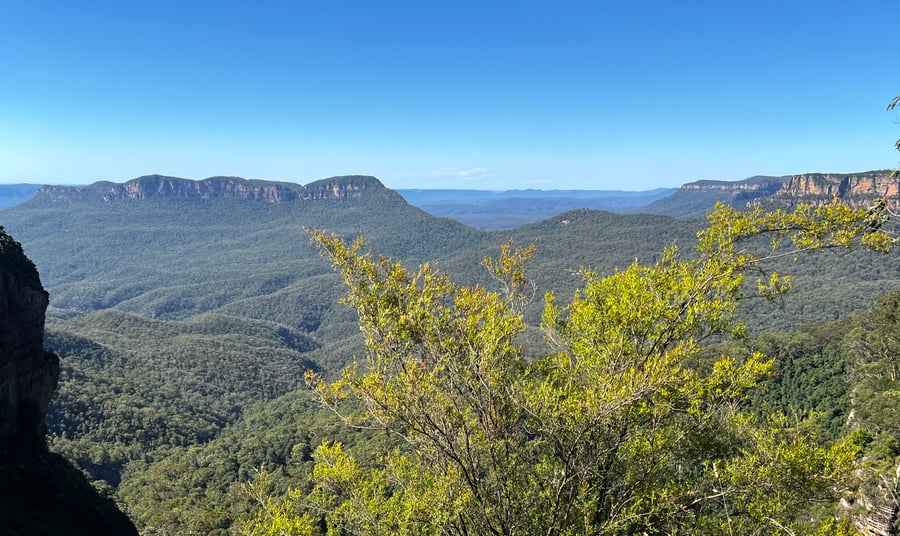
You can start a single trip in rainforest, cross a dry desert lakebed by lunchtime, and finish it in snow. New South Wales is the only Australian state that runs the full set: a subtropical rainforest coast in the north, an alpine spine of snow gums along its southern border, and a vast dry interior between them where the rivers run inland and disappear. Three of its national parks carry World Heritage listing for landscapes that have nothing in common with one another – the Gondwana rainforest of the northern escarpment, the sandstone canyons of the Blue Mountains, and the dry lunette of Lake Mungo in the far southwest, where the wind keeps uncovering some of the oldest ceremonial burials on earth.
The state falls into two very different halves. The coast and the tablelands behind it – where the food, the wine, and most of the people are – sit within a half-day of Sydney. The far west is another two days out: desert, river, and distance, where the towns are small and far apart and the light is harder. Sydney is the front door, but the trip that rewards the drive is the one that keeps going past it – south to the oyster coast, up onto the New England tableland, or the long haul west to the Darling and the dry lakes.
Food
On the Sapphire Coast you eat oysters on an open-air deck among the mangroves, a few metres from the lease they came off, and the growers describe their own Merimbula rock oyster as tasting like “eating ice-cream with sea spray on your face” – a bold mineral zing and a sweet, fruity finish that shifts from one estuary to the next. That is merroir, the oyster’s answer to terroir, and it is the clearest taste of a habit that runs the whole state: the best food here is tied hard to one patch of water or soil, and it rewards driving to the source to eat it where it is made.
The oyster coast, the Hunter's Semillon, Griffith's Little Italy, and Sydney's fish revolution
The Sapphire Coast oyster trail, far south coast. At The Oyster Barn on Merimbula Lake you perch on a deck over the water and order a mixed dozen -- the Japanese sesame-and-soy topping is delicate enough to leave the oyster's creaminess intact -- or carry a bag to the beach with a BYO bottle. Broadwater on Pambula Lake runs an "oyster school" where you shuck your own to the sound of bell birds, and Captain Sponge motors you out to the leases on a punt. The oysters are at their best through the cooler months.
The Hunter Valley, two hours north of Sydney. Australia's oldest wine region makes the country's one genuinely original white -- Hunter Semillon, picked early and never oaked. Young, it is pale as water and lemon-lean, almost austere; at ten or twenty years it turns honeyed and toasty with what Jancis Robinson calls a "woodsmoke and beeswax complexity" that no oak ever touched -- all at barely eleven per cent alcohol. It is the wine locals tell you to cellar, not drink young. Taste the aged releases at Tyrrell's (the Vat 1 line runs from 1963) and eat where they pour it. Year-round; vintage festivals fall in autumn.
Griffith, the Riverina. An irrigation town laid out by Walter Burley Griffin -- the architect of Canberra -- and settled by Italians, Veneto first and then Calabria and Sicily after the war, until it became the closest thing Australia has to a Little Italy. You swoon over a cream-filled cannoli at Bertoldo's, a family pasticceria making cannoli, nougat, and gelato on Banna Avenue since 1952, then argue with locals over whose pasta or burrata is best. On the edge of town, the Hermit's Cave is a warren of rock shelters and terraced gardens an Italian immigrant built by hand across two decades. Best in the cooler months.
Sydney's real food. Past the harbour postcards, the city eats by neighbourhood -- Cabramatta for the pho Luke Nguyen calls maybe the best in Australia, Marrickville for yum cha. At the top sits Josh Niland's Saint Peter in Paddington, the restaurant National Geographic says "started a fish revolution" by treating a fish like a side of beef: tuna dry-aged like ribeye, swordfish belly cured into "bacon," and a salt-and-vinegar whiting laid across sourdough as a "fish jigsaw puzzle" one critic called "a dish that represents Sydney." Book ahead; the menu changes with the catch.
Culture
In the far southwest, at Lake Mungo, you walk the crescent dune called the Walls of China with an Aboriginal guide from the three groups whose Country this is – across silt like the surface of the moon that turns bright orange at dusk. The wind is always uncovering things, and the guide’s rule is simple: if a stone tool lies loose you may pick it up and set it back, but if the sand still holds it, you leave it – “it hasn’t revealed itself yet.” It is the oldest continuous human story on the continent, and it sets the range of culture here: from the deep inland past to a free sculpture show on the Bondi cliffs, with the far west often the place where the art is the reason to go.
The Mungo lunette walk, the Brewarrina fish traps, and Armidale's keeping place and gallery
The Mungo lunette walk, far west. A two-hour guided walk onto the Walls of China leaves from behind the Mungo Visitor Centre (Mungo National Park, far west NSW) -- access to the lunette is by Aboriginal-guided tour only, walked with a guide from the three groups whose Country this is, the Mutthi Mutthi, Ngiyampaa, and Paakantyi. They read forty thousand years out of the eroding dune, past the site where the world's oldest known cremation, Mungo Lady, was found, and 20,000-year-old footprints. Tours run most days; the light is best late afternoon, and the unsealed drive in makes it a cool-months trip.
The Brewarrina fish traps, far north-west. On the Barwon River, half a kilometre of dry-stone weirs and ponds still catches fish as it has for thousands of years -- built, in the Ngemba telling, when the creator Baiame threw his net across the river. A guide from the Aboriginal Cultural Museum walks you along them. Some call them the oldest human-made structure on earth; the custodians deliberately don't, teaching that "oldest" is competitive talk beside what the traps actually are -- a living, still-used meeting place. Tours run daily; book at the museum.
Armidale, on the New England tableland. The tableland university city sets two collections side by side on Kentucky Street. The Aboriginal Cultural Centre and Keeping Place holds the largest collection of Aboriginal artefacts in New South Wales and tells the living story of the New England nations -- the Anaiwan, Kamilaroi, Dunghutti, Ngarabal, Banbai, and Gumbaynggirr -- through a bush-tucker walk, a yarning circle, and guided tours to significant sites out of town. Next door, the New England Regional Art Museum hangs the Howard Hinton Collection, one of the great acts of artistic philanthropy in the country: some 130 works by Streeton, Roberts, and the Lindsays, salon-hung, given to the old teachers' college between the wars. Both are free or by donation.
Sydney's free art and Broken Hill's outback galleries
Sydney's art, free and outdoors. For three weeks from mid-October, the Bondi-to-Tamarama coastal walk becomes the world's largest free sculpture show -- a hundred works strung along two kilometres of cliff, with whales sometimes passing offshore; go early to beat the crowds. Also free and year-round, the Brett Whiteley Studio in Surry Hills reopened in 2026 after a careful restoration: the preserved upstairs workroom holds the artist's unfinished paintings, his record collection, and a graffiti wall of scrawled quotes, kept down to the squeak in the floorboards. Open Thursday to Sunday.
Broken Hill, where the art is the reason to go. The far-west mining city was the first entire town on the National Heritage List. Twelve sandstone sculptures crown Sundown Hill in the Living Desert reserve, best at sunset when the stone runs from pink to scarlet and half the town arrives with a picnic -- come an hour early for the quiet. In town, the Pro Hart Gallery holds the vivid, crowded outback paintings of the ex-miner who became one of Australia's most recognisable artists. The sculpture site stays open until half an hour after sunset.
Natural History
The haze that names the Blue Mountains is eucalyptus – a fine mist of oil the forest breathes out, scattering the light blue across the Jamison Valley below the Three Sisters at Katoomba. That eucalypt is the thread that runs the whole state: the Greater Blue Mountains carries World Heritage listing for around a hundred species of it, an eighth of all the eucalypts on earth, and because most flower not to a calendar but on their own multi-year cycles, the natural history and the honey both change as you cross the state – from the gorge-cut tableland in the north to the alpine tops in the south and a volcanic skyline under the darkest sky in the country.
The eucalypt haze of the Blue Mountains and the gorge country of Waterfall Way
The Blue Mountains, an hour west of Sydney. The lookouts at Echo Point are the postcard, but the walks are the reason to stay: the Grand Canyon track near Blackheath drops down stone stairs into a fern-choked sandstone slot, follows a creek past dripping overhangs, and ducks behind a waterfall before climbing back to the rim. Nearby, Jenolan runs through some of the world's oldest open cave systems. The Three Sisters are Gundungurra and Darug Country; the haze is eucalyptus. Trains run up from Sydney in about two hours; the lookouts can fog in, so give yourself the day.
Waterfall Way and the Wollomombi gorge, New England. The 185-kilometre drive from Armidale to the coast falls off the tableland through five national parks. Its set-piece is Wollomombi, one of the highest waterfalls in the country, dropping around 220 metres into a narrow gorge; stand at the rim after rain and the chasm fills with mist and the odd rainbow while wedge-tailed eagles ride the thermals off it. The road ends in the Gondwana rainforest at Dorrigo. The falls run hardest after summer rain.
The alpine roof at Kosciuszko and the volcanic dark-sky country of the Warrumbungles
The Main Range, Kosciuszko, in the far south. The highest and most extensive alpine country on the mainland, and in summer the 22-kilometre Main Range loop from Charlotte Pass walks the roof of it -- past Blue Lake, one of only a handful of glacial lakes on the continent, across the infant Snowy River, and over Mount Kosciuszko, the mainland's highest point at 2,228 metres. Snow gums stand twisted by the wind at the treeline; above it, December to March, the herbfields flower with snow daisies and billy buttons. A true snow season closes the tops in winter. Five hours from Sydney.
The Warrumbungles, central west. A shield volcano eroded over millions of years has left a skyline of spires and domes near Coonabarabran -- the Breadknife, a ninety-metre blade of rock, is the emblem, and the 14.5-kilometre Grand High Tops circuit walks in among them, closer to Yosemite than to anything else in Australia. Then the sun goes down: this was Australia's first Dark Sky Park, the Milky Way overhead with no light pollution to dim it, and astronomers run guided night-sky sessions. Siding Spring Observatory is on the ridge. Spring for wildflowers; book the stargazing ahead.
Built Heritage
Walk up the timber ramp into the Kinchega woolshed, on the Darling near Menindee, and the lanolin is still in the air. Built in 1875 of corrugated iron and river red gum, the shed put something like six million sheep across its board in ninety-seven years, and the presses, the machinery, and the shearers’ stands remain where they were left – the wool once floated out down the river by paddle steamer. The buildings worth crossing New South Wales for sit at the two ends of its history: the deep inland, where wool and gold built at a scale that looks impossible now, and Sydney, where the colony began in convict stone.
The Kinchega woolshed, convict Sydney, the gold town of Gulgong, and a railway you ride
Kinchega Woolshed, the Darling near Menindee. Built in 1875 on a station that once ran to a million acres, it is a vast iron-and-red-gum building of 26 shearing stands; at the very first shearing, 72,800 sheep were shorn and the wool sent downriver by paddle steamer. It stands open and much as it was, on Paakantyi/Barkindji Country, now jointly cared for with the Menindee Elders -- you can even sleep in the old shearers' quarters. Reached on a good dirt road off Menindee; a cool-months trip.
Hyde Park Barracks, Sydney. The convict architect Francis Greenway built these Georgian barracks for Governor Macquarie between 1817 and 1819; they held tens of thousands of convict men, later became a depot for immigrant women, and are now UNESCO World Heritage. Entry is free, and the museum is unusual: a self-guided audio walk, eyes up, past sleeping hammocks and 4,000 artefacts archaeologists lifted from beneath the floorboards -- buttons, cloth, an intact convict shirt, much of it dragged under by rats. This is Gadigal land, and the walk up to The Rocks fills in the rest of colonial Sydney.
Gulgong, the Central West. The gold rush of 1870 threw up a town of twenty thousand almost overnight, and Gulgong kept the streetscape -- narrow, crooked lanes of verandahs and iron lace, so little changed that film crews still use it. Henry Lawson grew up here, and the town and the poet shared the first ten-dollar note; the Holtermann Museum shows the goldfields in 1870s photographs so sharp they sit on the UNESCO register. It's on the Mudgee wine-and-honey road -- the same run as the region's walk-in honey. Half a day.
The Zig Zag Railway, near Lithgow. To haul trains up the western wall of the Blue Mountains in 1869, engineers built a zig-zag of sandstone viaducts and tunnels, a marvel of its day. A volunteer co-op runs heritage steam over it again: after bushfire and a decade dark, the line reopened in 2023, and you ride down the escarpment with the windows open, through the tunnels, the locomotive running around at each end. Fifteen minutes from the Blue Mountains proper; four rides a day.
I want to dig deeper
Enough of the overview. The far west and the inland reward the traveller who commits to them, and it is genuinely strange country out there – towns that live underground to escape the heat, a mine carved into a sandstone cathedral, a space telescope in a sheep paddock, a pub that has starred in a dozen films. Three deep runs take it in: the opal country, the Central West oddities, and the river road that built the west.
The opal country: Lightning Ridge and White Cliffs -- any season, though the underground stays cool when the surface hits fifty
New South Wales holds two of the strangest towns in the country, both built on opal and both, in large part, underground. At Lightning Ridge -- the black-opal capital, nine hours north-west of Sydney -- you navigate by the Car Door Tours, self-drive routes that two locals marked with brightly painted car doors staked along the roadside; they lead to Amigo's Castle, hand-built over forty years by one Italian miner from ironstone boulders, and to the Chambers of the Black Hand, a worked-out mine twelve metres down where a former Royal Marine has carved nine hundred figures into the sandstone, from the Last Supper to every Australian prime minister. End the day free in the artesian bore baths, 41 degrees straight from the Great Artesian Basin, under the stars.
Further south-west, White Cliffs is a moonscape of fifty thousand mine mounds where most of the town lives in dugouts at a constant 22 degrees. You can sleep underground in the mesa-carved rooms of the Underground Motel, tour a local's dugout home, and play a round on a grassless golf course among the saltbush and rusting tractors. Do either town in a day, or string the two into a week.
The Central West: the Parkes dish, the Elvis town, and the Mudgee gold-and-honey country -- Elvis in January, otherwise any season
West of the Blue Mountains, the Central West strings together a run of genuine oddities. Outside Parkes, in the middle of sheep paddocks, stands Murriyang -- the 64-metre radio telescope known as the Dish, which relayed the Apollo 11 moonwalk to the world and later starred in its own film; you can walk almost to its base, and the visitor centre is free. Parkes turns stranger still once a year, when tens of thousands of fans pour in for the Elvis Festival each January and the whole town becomes Graceland. North of there, the gold-rush streets of Gulgong -- the Ten Dollar Town -- run into the Mudgee wine country, where cellar doors sit among the vineyards and Mudgee Honey Haven pours its own ironbark and yellow box straight from the Central West box country. A weekend loop, or a slow week.
The Darling River Run: Bourke to Wentworth -- a cool-months drive, some sections unsealed
The Darling River Run follows the river down the length of the outback -- Bourke and Brewarrina at the top, through Louth, Tilpa, Wilcannia, and Menindee to Wentworth, where the Darling meets the Murray. It threads almost everything the rest of this page only points at: the Kinchega woolshed and the Menindee Lakes, the Aboriginal-guided lunette at Mungo on a detour south, and the river-port sandstone of Wilcannia. Off its western end, past Broken Hill, the ghost town of Silverton is the outback as the movies use it -- the 1884 hotel and the Mad Max 2 Museum, and the Mundi Mundi plains beyond, where the road runs so straight you can see the curve of the earth. Much of the run is unsealed but graded for two-wheel-drive in the dry; this is a cool-months trip, as summer runs past forty and rain closes the roads. Go slowly -- the distances are long and the point is the country between the towns.
The Honey of New South Wales
Its honey follows the same logic as the state – it changes as you cross it, and the biggest surprise sits at the bottom of the ladder. New South Wales makes more honey than any other state, and its single largest honey is a weed: Paterson’s Curse, sold without irony as Salvation Jane, a purple import that graziers fight and beekeepers bless for the early flow it throws across the inland. Because it carries traces of the alkaloids that make the plant toxic to stock, it is usually sold blended – and it has its own page here. Around it sits the rest: the box, ironbark, and yellow box of the western slopes, which despite the dark-sounding tree names run extra-light to light amber and mild; the smooth spotted gum of the south coast; the cold-country honeys of the tablelands; the bioactive jellybush of the North Coast, sold as Australian manuka; and the heath banksia, whose flowers the Cadigal once steeped in water for a sweet drink. None of it flowers to a calendar, which is why a New South Wales beekeeper follows the bloom rather than waits for it. Varroa mite reached the Australian mainland here, at the Port of Newcastle in 2022, and is now a managed part of beekeeping, as it long has been everywhere else in the world. The way to read the state’s honey is the way to see the state: go to where it is made.
The Honey Road
One route, organised around the honey. Everything else is what you pass on the way to it.
Sydney -- year-round (start here)
Taste the range before you drive: the weekend growers' markets and providores carry Central West Salvation Jane, tableland yellow box, and south-coast spotted gum under one roof -- the fastest way to find what is worth chasing before you commit the kilometres.
Southern Highlands -- weekends (walk-in)
On the grounds of the Retford Park estate at Bowral, Bowral Honey Farm is the state's best honey visit: veil on, you walk among the hives, then taste six floral-source honeys on a terrace over the lake with morning tea -- or book the hands-on session and press your own warm honey by hand. The shop opens weekends, and the Ngununggula gallery and a cafe share the grounds.
Jervis Bay, south coast -- by booking (walk-in)
At Woollamia, five minutes from Huskisson, Bay and Bush's apiary suits you up in the coastal bush to hold a frame of bees, hunt for the queen, and taste raw honey straight from the hive.
Hunter Valley -- by booking (walk-in)
Among the vines at Broke, tap your own raw honey from a Flow Hive in the lavender rows at Hunter Lavender Farm, then taste at Honey Wines Australia, the Hunter's only meadery, where the local honey is fermented into mead.
Central West, Mudgee -- most days (walk-in)
Mudgee Honey Haven, a honey house and cafe on the wine-and-honey road, pours its own ironbark, yellow box, and bush honey -- the closest you will get, at a counter, to the box country that carries the state's biggest eucalypt flows.
What to buy, not visit
Two of the finest small producers sell online rather than at a gate: Malfroy's Gold works wild yellow box from Warre hives in the Blue Mountains world-heritage country (raw, and rated for activity on the makers' own testing), and Wall's Honey Co. moves single-origin honey hive to hive across New England, stocked in Armidale shops. And the state's number-one honey keeps no cellar door at all: Paterson's Curse flows inland where the producers are wholesale, so Salvation Jane honey is a specialty-store and online buy, usually blended -- the one New South Wales honey you chase by name, not by map.
Getting Here
Sydney is the arrival point and the gateway to most of the state: the south coast and the Sapphire Coast oyster country run south from the city; the Southern Highlands sit ninety minutes southwest; the Blue Mountains rise an hour to the west; the Central West – Bathurst, Parkes, Mudgee – is two to four hours on; and the New England tableland and Waterfall Way are a half-day’s drive north, or a short flight to Armidale. A car is essential for almost all of it – the honey, the food, and the landscapes are spread across a very large state, and public transport thins out fast beyond the coast.
The far west is a different scale of distance. Broken Hill, Mungo, Menindee, and the Darling River Run are the better part of two days’ drive from Sydney, or reached by flying to Mildura (just over the Victorian border) or Broken Hill and driving in from there; the opal towns of Lightning Ridge and White Cliffs are further still. The interior is a cool-months destination: summers out west run past forty degrees, the unsealed roads turn to mud and close after rain, and the river and opal country is at its best from autumn through spring. On the coast and the tablelands the seasons are gentler, though the high country has a true cold winter and a genuine snow season along the southern border.
Seasonal Events Not to Miss
A handful of the state’s signature events are worth timing a trip around, and they span its full range – coast, country, and the inland.
Two of the country’s biggest events fill inland towns each January. The Parkes Elvis Festival draws more than 25,000 fans to the small Central West town of Parkes around Elvis Presley’s birthday – 6 to 10 January in 2027 – a genuinely strange and much-loved fixture in the middle of wheat-and-honey country. A week later, the Tamworth Country Music Festival turns the self-declared country-music capital into ten days of concerts and street performance – 15 to 24 January in 2027 – the largest music festival in Australia, and Tamworth is the home base of the New England beekeepers the Honey Road runs to.
In autumn, Orange FOOD Week – Australia’s longest-running regional food festival, running since the early 1990s – fills the Central West’s cool-climate wine country with close to a hundred events over ten days, 2 to 11 April in 2027: the clearest taste of the produce-tied-to-place idea the Food section describes.
On the south coast, the Narooma Oyster Festival runs over the first weekend of May – its twentieth edition on 7 to 9 May 2027 – built around the Sapphire Coast’s growers, an Australian Oyster Shucking Championship, a Yuin Welcome to Country, and the oysters of Wagonga Inlet at their cool-season best. It is the clearest single window onto the merroir idea the Food section describes, and it sits right on the oyster trail.
Where to Buy Honey
The honey is best bought close to where it is made, and the Honey Road above is the fuller guide. In short:
In the Southern Highlands, Bowral Honey Farm sells its own cool-climate honey from a weekend shop on the Retford Park estate. At Jervis Bay and in the Hunter Valley the honey comes with a visit – Bay and Bush’s apiary at Woollamia, and Hunter Lavender Farm and Honey Wines at Broke, all by booking. In the Central West, Mudgee Honey Haven pours its own ironbark and yellow box on the Mudgee wine road; and the North Coast is where to buy jellybush sold as Australian manuka, from producers such as Australia’s Manuka and Mid Coast Honey.
The state’s two most awarded small-batch producers sell online rather than at a gate: Malfroy’s Gold (Blue Mountains wild yellow box) and Wall’s Honey Co. (New England single-origin, stocked in Armidale). And Salvation Jane – Paterson’s Curse honey, the state’s biggest – is a specialty-store and online buy, usually blended.