Standards, Quality & Buying

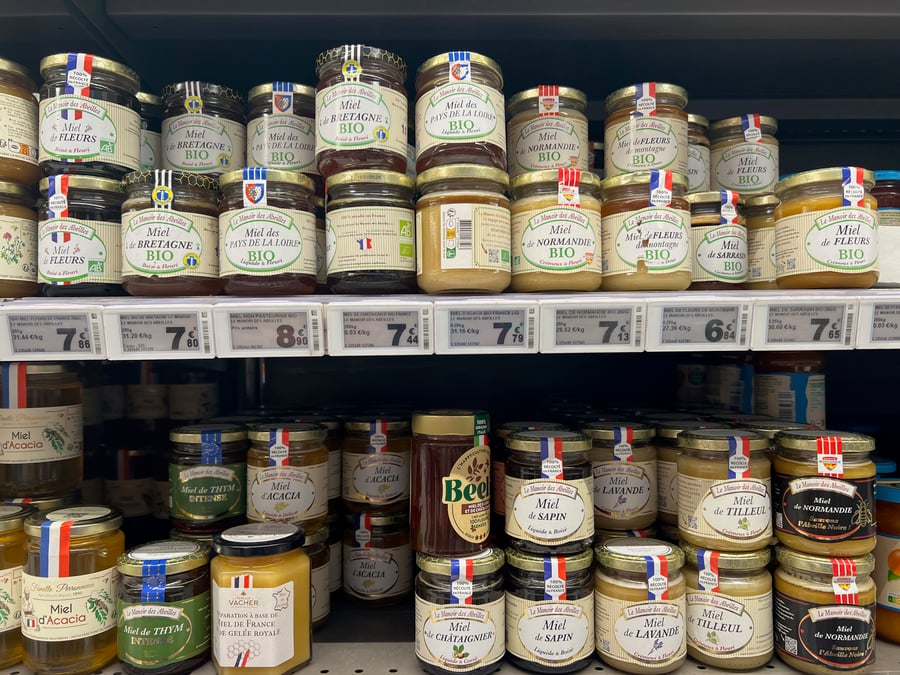
Two supermarket shelves of honey jars with cream labels and blue, white and red bands, above a rail of electronic price tags.
Photo: HoneyTraveler
A supermarket honey shelf, Rueil-Malmaison
Two shelves of honey at a supermarket in Rueil-Malmaison, in the Paris suburbs, 5 October 2026. The upper shelf holds organic honeys named for Brittany, the Pays de la Loire and Normandy; below them acacia, thym (thyme), chataignier (chestnut), sapin (fir), tilleul (linden) and lavande (lavender). About half the jars carry a band reading "100% recolte en France"; others carry a regional band, a European flag or, on one jar, "100% origine Italie". The shelf tags give the price and, on most, the price per kilo, which is how a 250 g jar is compared with a larger one.

As a buyer we should expect honey to be just honey. Honey sold as honey should have nothing added to it, and nothing taken out of it beyond what the removal of foreign matter makes unavoidable.

The guides in this section are written for the buyer. They explain what a standard such as Codex defines and what national standards there are; what graders measure for a grade such as the United States Department of Agriculture’s and what they leave unmeasured; what a label is required to say and how far it can be trusted; what a seller means by raw and by organic, and what neither word covers; how blossom honey differs from honeydew honey; why two jars of the same honey can taste different; and what stingless bee honey is, and what a buyer finds in its jar.

Buyer's Guide Honey comes in two basic types, blossom and honeydew, as single-flower or multifloral, and is sold as comb, extracted, crystallized, filtered or creamed. This guide explains each. Honey Standards Honey standards define what may be sold as honey: no added sugar, no pollen removed, no overheating, and a label naming the source. This guide covers the main ones. USDA Honey Grading The USDA honey grade is a voluntary trade score for moisture, defects, flavor and clarity. It says nothing about purity, origin or heating. Some states set binding rules. Honey Quality Labeling Honey labels are governed by different rules in different places. This guide compares what USDA grades, USDA organic, Certified Naturally Grown and the EU directive each require, term by term. Raw Honey Raw honey is unheated and only coarsely strained. This guide covers how heating and fine filtering change honey, why raw honey crystallizes, and what a Brix reading shows. Organic Honey Organic honey means the hives, the forage and the handling meet an organic standard that a certifier has checked. This guide compares the US, EU, Canadian, UK and Australian rules. Example Organic Honey Standard (QAI) One certifier's organic honey standard, reprinted with permission from Quality Assurance International: the hive placement, feeding, treatment and harvesting rules a beekeeper accepts when a jar is certified organic. Blossom or Nectar Honey Bees make blossom honey from flower nectar and ripen it in the comb. This guide covers extraction and straining, the processing that damages honey, and buying from the beekeeper. Honeydew - Forest Honeys Honeydew honey is made from the sweet droppings of aphids and scale insects on trees, not from nectar. What it is, how it tastes, and why it is prized. Stingless Bee Honey Stingless bee honey comes from tropical bees that store it in sealed resin pots, so it is thinner, more acidic and tangier than honeybee honey, and is kept cold. Why Did Two Jars Labeled as the Same Type of Honey Taste Different? Two jars labeled as the same type of honey can taste different: honey is a biological product, and biology varies with season, weather, bloom and landscape.