
Spotted Gum Honey
The Story
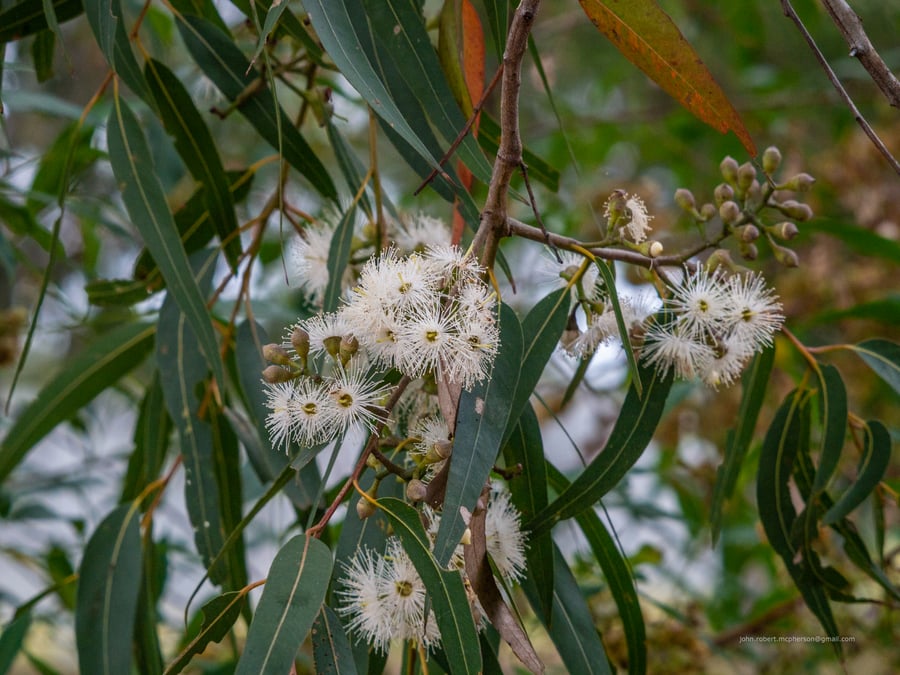
Most eucalypt honeys arrive on a schedule. Spotted gum does not. The tall, mottled-barked trees of the New South Wales coast flower only every few years, and when they do the flow can be enormous, so the honey comes in waves of abundance separated by long quiet stretches rather than in a dependable annual crop.
When the bloom comes, it announces itself: the cream flowers carry a scent so strong that the honey can be smelled on the air beneath the canopy. The result is a pale, gentle, caramel-edged honey that is among the most approachable of all the Australian eucalypts, and one whose supply is tied directly to the rhythm of the forest rather than the calendar. The 2020 bushfires along the New South Wales coast struck many of these forests, and their recovery will shape how much spotted gum honey is available in the years ahead.
Characteristics
Spotted gum honey is extra light to light amber, clean and pale in the jar. The flavour is smooth and mild, carrying the warm caramel note that producers return to again and again, without the heavier resinous weight of the darker eucalypt honeys. The aroma is the same honey scent that hangs under the trees in bloom. It is slow to granulate, but when it does it sets to a coarse brown grain rather than a fine cream, a texture some prize for the way it sits against soft cheese. Like all raw honey it will crystallise in time, and warming the jar gently returns it to a pour.
Click to Display — The Details: botanical origin, sensory profile, pairings, health and what gives it its character
Botanical Name: Spotted Gum (Corymbia maculata)
Botanical Family: Myrtaceae
Bee Species:
Apis mellifera, the introduced European honey bee, which carries all commercial spotted gum production. Spotted gum’s tall coastal forests lie largely outside the range of Australia’s native stingless bees, so the honey is a managed-hive product worked by migratory apiarists following the irregular bloom.
Color:
Extra light to light amber
Flavor Profile:
Smooth and mild, with warm caramel undertones
Tasting Notes:
Smooth and mild on the palate, leading with a warm caramel note and none of the resinous bite of the darker eucalypt honeys. The body is gentle rather than assertive, which is what makes it an everyday honey rather than a tasting one. It is slow to granulate, and when it does it sets to a coarse brown grain rather than a fine cream – a texture some prize against soft cheese.
Aroma:
warm and honey-scented, the same sweet fragrance the flowering trees throw on the air
Forage Origin:
Spotted gum honey is gathered from the nectar of Corymbia maculata, a tall smooth-barked eucalypt of the open forests that run down the New South Wales coast from around Taree in the north to the Bega Valley in the south, with a disjunct stand near Orbost in eastern Victoria and the species reaching north into southeast Queensland. The trunk sheds its bark in patches to leave the mottled, spotted surface that gives the tree its name. It is a major nectar and pollen tree, and its cream flowers carry a scent so strong that beekeepers often smell the honey on the air before they see the bloom, most noticeably in the morning and evening.
Two close relatives share the name spotted gum and are easily confused with it: the lemon-scented gum (Corymbia citriodora), whose leaves carry a citronella oil that C. maculata lacks, and the large-leaved spotted gum (Corymbia henryi), concentrated in southeast Queensland. The honey of this page is from C. maculata, the species of the New South Wales coast. The tree is also one of Australia’s most important hardwood timbers, which is the form in which most people meet it.
Pairings:
A mild, caramel-edged honey, spotted gum suits everyday use rather than standing as a flavour of its own: stirred into coffee, where its caramel note carries, or spooned over yoghurt and toast. Its coarse crystallised grain is the part worth pairing deliberately, set against a soft, creamy cheese.
Origin Story
Long before it was valued for honey, spotted gum was valued for its timber: it remains one of Australia’s most important native hardwoods, prized for strength and the attractive fiddleback figure of its grain, and used for everything from flooring and decking to poles and tool handles. The mottled trunk that gives the tree its name comes from bark that sheds in patches through summer. The genus itself is unsettled: described by Hooker in 1844 as Eucalyptus maculata, moved to Corymbia by Hill and Johnson in 1995, and still carried under the older Eucalyptus name in parts of the honey trade.
Harvest & Forage
Spotted gum flowers irregularly, in the manner of most eucalypts: good nectar flows come only every three to four years, from the end of autumn through to spring, rather than every season. When a flow does come it can be heavy, yielding up to about 60 kilograms of honey per colony in a strong year. The harvest is tied to that episodic bloom, so supply swings from abundance to scarcity between years. The 2020 bushfires along the New South Wales coast damaged many spotted gum forests, and their recovery will shape future flows.
Beekeeping Context
Spotted gum is worked by the introduced European honey bee within a migratory industry: because the tree flowers only in some years and across a coastal range from southern New South Wales into southeast Queensland, commercial beekeepers move hives to follow the bloom rather than holding them in one place. The high sugar content of the nectar, strongest in the mornings and evenings, makes a good spotted gum flow a prized event in the beekeeping calendar.
Festivals and Fairs
- Sydney Royal National Honey Show (Royal Agricultural Society of NSW) – Australia’s premier honey competition, first judged in 1888, which shows single-varietal eucalypt honeys including spotted gum in its light-amber classes.