Yellow Box Honey
The Story
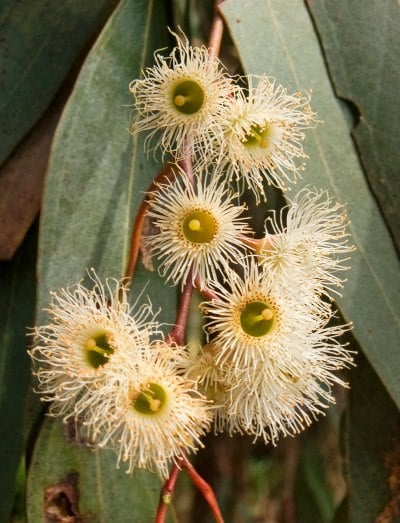
Yellow box has been the most popular single-varietal honey in Australia for more than a century, the default honey on the table. Pale, mild, and slow to crystallise, it owes those qualities to an unusual sugar chemistry: a high ratio of fructose to glucose. That single property determines both of the things yellow box is known for. It resists crystallisation, staying liquid for many months to years, and it carries the lowest glycaemic index of any Australian honey, measured around 35. The honey that disappears into a cup of tea is doing more chemical work than its mildness suggests.
Characteristics
Yellow box is among the lightest of the eucalypt honeys, extra-light to pale amber, sometimes described as hay-coloured. The aroma is gently floral, reflecting the honey-scented blossom of the tree itself. On the palate it is mild, sweet, smooth, and full-bodied, with a buttery quality and faint citrus or fruity notes, and a clean rather than lingering finish. Its defining physical trait is stability: the high fructose-to-glucose ratio keeps it liquid far longer than most Australian honeys, often for years. It is the reference point against which other Australian table honeys are usually described.
Click to Display — The Details: botanical origin, sensory profile, pairings, health and what gives it its character
Botanical Name: Yellow box (Eucalyptus melliodora)
Botanical Family: Myrtaceae
Bee Species:
Apis mellifera, the introduced European honey bee, which carries all commercial yellow box production. The bee was brought to Australia in 1822; yellow box grows mostly outside the range of the native stingless bees, which do not occur through most of its inland temperate country.
Color:
extra-light to pale amber, among the lightest of the eucalypt honeys; sometimes called hay-coloured. Cold-pressed wild versions are cloudier and deeper gold
Flavor Profile:
mild, sweet, smooth, full-bodied; buttery, with faint citrus or fruity notes
Tasting Notes:
Mild and clean, sweetness arriving first with a soft buttery body behind it. Faint citrus and light fruit sit under a gentle floral aroma, and the finish is clean and short rather than lingering or bitter. It reads as smooth and rounded, without the resinous edge of the darker eucalypt honeys – which is what makes it an everyday honey rather than a tasting one. Cold-pressed wild yellow box, such as Malfroy’s Gold, is a markedly richer and more aromatic expression; see Beekeeping Context.
Aroma:
gently floral, reflecting the honey-scented blossom
Defining Compounds:
A high ratio of fructose to glucose. This sugar profile, rather than any single trace compound, is what gives yellow box both its slow crystallisation and its low glycaemic index.
Forage Origin:
Yellow box honey comes from the nectar of Eucalyptus melliodora, a medium-to-tall eucalypt of south-eastern Australia, found from the Victoria-South Australia border northeast through New South Wales into south-central Queensland and the ACT. It grows mainly on lower slopes in grassy woodland and on farmland, and has one of the widest natural distributions of any honey-producing eucalypt, second only to river red gum. The tree’s own name records its value to bees: melliodora means honey-scented, after the strong fragrance of its flowers. It is the only Australian eucalypt whose Latin name names its honey. Like most eucalypts it flowers irregularly, yielding nectar mainly over the hot, dry summer and well in only one year in two to four. The main flow is a single summer window, not an annual harvest.
Pairings:
A mild, all-purpose honey, yellow box is the standard table choice: stirred into tea or coffee, spooned over yoghurt, drizzled on pancakes or toast, and used in baking, where its slow crystallisation keeps it pourable. Its low assertiveness makes it a sweetener rather than a flavour – it pairs by disappearing into other things rather than standing against them.
Health Uses:
Yellow box’s main health-relevant property is its low glycaemic index, the lowest recorded for an Australian honey, which follows from its high fructose-to-glucose ratio and is why it is sometimes chosen as a lower-GI sweetener. Otherwise it is a table honey rather than a medicinal-grade one: its antibacterial activity is the ordinary hydrogen-peroxide kind, not the high non-peroxide activity that defines jarrah or jellybush. The unusually active Malfroy’s Gold yellow box discussed under Beekeeping Context reflects a method of beekeeping, not a property of the honey type.
Origin Story
Yellow box has been a commercial honey in Australia since the nineteenth century, and for most of that time the most widely sold single-varietal in the country. Its history is tied to the woodland it comes from. Yellow box grows alongside white box and Blakely’s red gum in the Box-Gum Grassy Woodland, a community that once covered large areas of the inland slopes of south-eastern Australia and has been cleared for agriculture since European settlement. That woodland is now listed as a Critically Endangered Ecological Community under Australian federal law, and Eucalyptus melliodora itself is assessed as Vulnerable on the IUCN Red List, on the basis of long-term population decline. The same land clearing that built Australian farming has been removing yellow box trees for two centuries, which makes the country’s most ordinary honey also the one whose forage it has been losing the longest.
Cultural Context
Yellow box is the everyday honey of Australia – for over a century the most popular single-varietal in the country, the one most households grow up with and the benchmark other domestic honeys are measured against. Its standing comes precisely from being unremarkable on the table: a general-purpose honey rather than a specialist’s, valued for blending into tea, baking, and breakfast rather than for a character of its own.
Harvest & Forage
Yellow box flowers irregularly, in the manner of most eucalypts: it yields a strong nectar flow well in only one year in two to four, and mainly over the hot, dry summer, roughly December to February and shifting earlier in warmer parts of the range. The harvest is a single summer window per flowering year rather than an annual crop, which makes supply variable from season to season. Recorded yields reach up to about 75 kilograms per colony in a good year.
Beekeeping Context
Yellow box is worked by the introduced European honey bee within a migratory industry: because the tree flowers irregularly and only in some summers, commercial beekeepers move hives to follow the bloom rather than keeping them in one place. New South Wales carries the highest production, through the box-ironbark belt of the inland slopes. Most yellow box reaches the table as a pale, liquid, centrifuge-extracted honey. A few producers work it differently. Malfroy’s Gold, in the Central Tablelands of New South Wales, keeps bees in Warre hives on natural comb and cold-presses the honey rather than spinning it, which leaves it cloudy and deep gold and carries through high levels of pollen and propolis. Independent testing has rated their yellow box at TA 25+ on the Total Activity scale used for non-Manuka honeys. The producer attributes that activity to the hive method and the pressed comb rather than to the nectar – a reminder that yellow box is not, as a flower, a medicinal-grade honey, and that how a honey is kept and pressed can matter as much as what the bees foraged.
Source Regions
- New South Wales – highest production; the box-ironbark belt of the inland slopes
- Victoria – central and north-eastern box-ironbark country
- South Australia – eastern districts toward the Murray
- Southern Queensland and the ACT – northern and eastern edge of the range
Festivals and Fairs
- Sydney Royal National Honey Show (Royal Agricultural Society of NSW) – Australia’s premier honey competition, with a recognised light-amber single-varietal class in which yellow box is shown.