France Honey
The French honey year runs on past December. It opens in the Corsican clementine groves in spring and ends on ivy and arbutus, the strawberry tree, in the maquis (the evergreen scrub that covers the island), in a harvest taken as late as February. France reaches from the Atlantic to the Mediterranean and from the northern plains to the Alps and the Pyrenees, and its departments, the districts France is divided into, run on into the tropics: Réunion and Mayotte in the Indian Ocean, Guadeloupe and Guyane in the Americas; New Caledonia, a collectivity in the Pacific, keeps bees under its own law. The flowering calendars are written region by region, and there is no national one. In 2024 the biggest crops were summer polyfloral, honey made from many flowers at once, a quarter of the year’s honey, and sunflower, a tenth of it and the largest of the single-flower honeys.
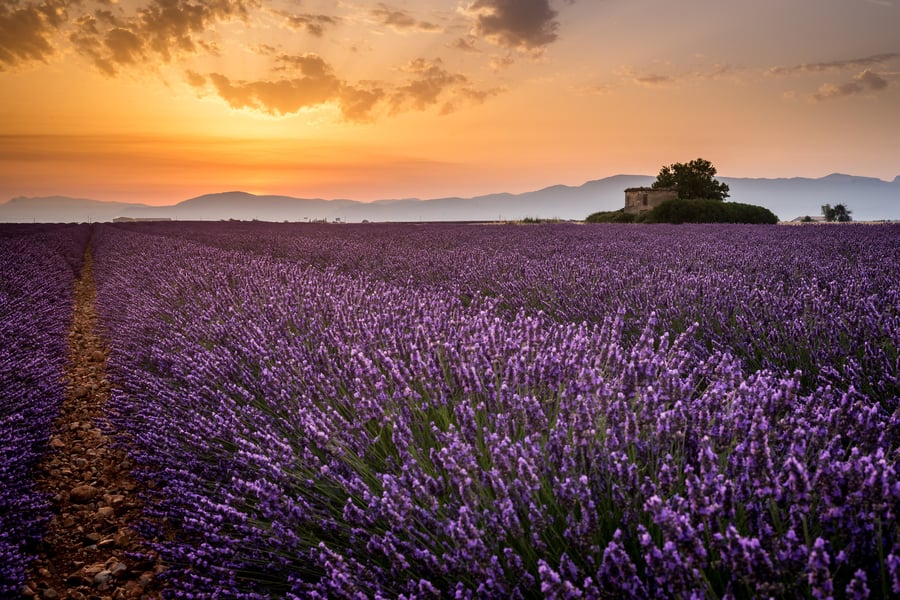
Miel de lavande is the French honey that reaches the specialty grocers abroad: Fortnum & Mason in London and Zingerman’s in Michigan both list it. France backs it with an instrument no other French honey holds. INAO, the institute that governs French designations, runs both signs and keeps them apart: an appellation certifies where a thing came from, as it does on a wine label; Label Rouge certifies a quality above the ordinary product, and a honey carries it only by being shown in sensory panels to taste better than the ordinary version of itself, and keeps it only by passing those panels again. INAO’s register lists two Label Rouge honeys, both Provençal, and lavender’s is older than the IGP (the European geographical indication) it now sits under.
The tropical departments are France too, and their honeys carry names no mainland jar does. The Paris counter sells two single-flower honeys from Guadeloupe under the local names of their trees, tandakayou and mombin, and baie rose from Réunion, the honey of the pink-peppercorn tree and the island’s largest crop. Réunion’s older name is miel vert, the honey of the tan rouge, a tree of its mountain forests found nowhere else but Mauritius, which Cordemoy’s flora called renowned in 1895. On Mayotte honey is still gathered from wild colonies in the forest, a practice the islanders hand down and count as their own, and the bee there is still thought of as a wild animal. Mayotte’s honeys and Martinique’s are not on that counter, so for those you would have to go.
A single-flower honey, a monofloral, is a matter of timing: the hives go onto a flow while it runs and come off before the next one starts, and miel de bourdaine, which its Landes growers sell as a rare cru, shows the rule at its narrowest, since alder buckthorn takes only damp, acid ground and even there the flowerings overlap. Seven in a hundred French beekeepers moved their hives to follow the flowering in 2024, and they brought in a quarter of the crop; FranceAgriMer gives the purpose as widening the range of honeys rather than raising the yield, and the flows they seek are the ones the jar sells on: acacia and chestnut, the two the survey’s beekeepers sought most for the price.
The bee that makes it is a hybrid, and the state says so: decades of importing have hybridised essentially the whole French stock. Five pure races are nonetheless kept and named by the state: carnica, ligustica, caucasica, mellifera, the abeille noire (the black bee), and Apis mellifera unicolor, the bee of Réunion and Mayotte, native to Madagascar and the islands round it, whose Réunion population is itself half European in its nuclear genes. Guadeloupe and Guyane keep stingless bees, which are not honeybees at all. Guadeloupe’s is the mélipone, which the island’s beekeepers’ association records as found on no other island; its honey is ti poban, and since 2020 the state has protected the bee outright, so no colony may be taken from the wild. Guyane’s honeybee is Africanized: the African bee brought to Brazil in 1957 crossed with the European races the colonists had already introduced, and the cross reached Guyane in the 1970s. To hold the black bee, Corsica, Belle-Île and Ouessant have been closed to imported bees by order.
France eats about 45,000 tonnes of honey a year and in 2024 made about half of it. The gap is filled by imports, and honey that is blended and repackaged on the way to a French jar can be given the wrong origin or cut with syrup, neither visible in the jar, so the buyer’s question is whether the honey is what the label says.
A customer paid for a pollen analysis, and 140 tonnes of honey sold as French turned out to be Spanish
On 5 July 2023 the court at Perpignan convicted the director of Miel du Roussillon, a company wound up since 2019, of misleading commercial practice and deception over the origin of honey: between 2015 and 2018, the DGCCRF's enquiry found, 140,000 kilograms of Spanish, Romanian and Chinese honey had been sold as French. It came to light when a customer in the Haute-Loire had a private laboratory read the pollen in the honey and the laboratory found Spanish pollen; the state's laboratories confirmed the reading, and inspectors in the Hérault then caught drums being received, relabelled with a French origin and sent on. The sentence, passed in his absence, was a fine of 50,000 euros and six months suspended.
Every honey carries the pollen of the flowers it came from, and the mix places it. INAO's register calls pollen the honey's identity card, the Corsican appellation writes a pollen check into its control plan, and since 14 June 2026 a honey stripped of its pollen may not be sold in France as honey at all. The DGCCRF's last published campaign, in 2021, controlled nearly three hundred businesses and analysed 176 honeys; four in ten of each showed an anomaly, and nearly all of those ended in a warning, with two prosecutions. The anomalies it lists are labels as often as honey: the words miel pur and 100% naturel, forbidden because honey is pure by definition; health claims, none of which is authorised for honey; and beekeepers reselling bought-in honey as their own.
The specialist houses run the same tests on themselves. La Maison du Miel publishes a charter under which every harvest goes to independent laboratories for six analyses the law does not require, the last of them a pollen map to catch a false origin; it pots at no more than the temperature of the hive, forty degrees, and analyses again after potting; and it states that no beekeeper heats honey at extraction, so that the words récolte à froid on a jar are, in its phrase, a non-sens. The charter promises its customers honest information "sans mauvaise poésie", without bad poetry.
Hedène, a Paris house founded in 2013, names a department on every jar, and the same honey has carried different departments in different years: the department is a statement about that harvest, not a permanent address. The beekeepers' own reading of the decade is in the reason the Syndicat National d'Apiculture gave in 2026 for asking its members to open their mielleries to the public for five days in September: for years, it wrote, the media have spoken of honey only to speak of fraud.
In 2024 two-thirds of French honey went into its jar by the beekeeper who produced it and never passed through a blender, and it is sold wider than the farm gate: the Sunday market, the roadside miellerie (where the honey is spun and jarred), the producers’ shop, the cooperative counter.
Two bodies publish two sizes for the same French crop, and the register of beekeepers grows faster than beekeeping does
The state's register held 68,571 beekeepers at the end of 2023, nine in ten of them with fewer than fifty hives; the tenth who keep more made three-quarters of the 2024 crop. The register had grown by nearly five thousand in a year, and FranceAgriMer gives the reason: a campaign by the agriculture ministry reminding beekeepers of their duty to declare, not a rise in beekeeping. The hives themselves are counted each winter, and their number has risen by a quarter in seven years while the crop has not.
The crop swings. FranceAgriMer's series for the ten years to 2024 runs between a low of about 16,000 tonnes in 2016 and a high of nearly 32,000 in 2020, consecutive years differ by up to 60 per cent, and 2024's 21,585 tonnes sits, in FranceAgriMer's own words, close to 2019 and 2021 after two years above 30,000. There is no downward line through those figures, only the swing.
For 2025 two bodies published two sizes. InterApi, the interbranch body, estimated 38,300 tonnes, the best year since 2014, from a survey of 782 beekeepers weighted to those with more than fifty hives. The beekeepers' union UNAF put the year between 23,000 and 25,000 tonnes from what its departmental syndicates and the packers it deals with reported, calls that a range and not a count to the tonne, and sets it against surveys it calls unrepresentative. This page uses the state observatory's figures, FranceAgriMer's, each with its year.
Two near-record crops in 2022 and 2023 met a selling crisis: in 2023 a quarter of the beekeepers with more than fifty hives reported trouble selling, most of them left with honey unsold, because wholesalers facing higher prices kept their largest suppliers and let the other contracts lapse. The consequence FranceAgriMer records for 2024 is that direct sale rose to 41 per cent of the volume sold, the largest single outlet, which is where the buyer meets the beekeeper.
Some of the sellers were built by beekeepers: Les Compagnons du Miel, a cooperative that checks its members’ honey in its own laboratory; La Maison du Miel, founded, the house says, by the president of the beekeepers’ union; and Famille Mary, which began with one soldier’s two hives.
A soldier wounded in 1916 learned beekeeping at a school beside the Swiss hospital where he convalesced, and started with two hives at a watermill in 1921
Jean Mary was wounded in 1916 and sent to convalesce in Switzerland, at a hospital that stood next to a beekeeping school. He came home with the trade, and seven of his ten children went into the business after him.

The other answer is a name a beekeeper can defend, and the beekeepers build those names themselves: a group forms an organisme de défense et de gestion (a body constituted to defend and manage the name), writes its own specification, and puts it to INAO. A specification is narrow. Corsica’s excludes cultivated plants apart from the citrus groves. The Vosges’ names the tree and the insect: the honey is honeydew, the sweet residue aphids leave on the silver fir, gathered from the tree and not from a flower, and its name stood in a Nancy court in 1952 before any appellation existed. The Cévennes’ writes the chestnut in as a marker of the place, in a country where honey was long the only sugar on the table, and writes lavender out, as Provence’s writes out sunflower and rapeseed. Alsace’s asks only that the hives stand in its two departments and lets the honey be jarred outside them, six honeys under the one name since 2005, from all-flower to fir. Picardie’s, registered in November 2025, covers one honey, the lime, and proves it by chestnut and bramble pollen because the lime sheds so little of its own. The Landes’ is still an application, published by the Commission in June 2026 and open to objection until September, for seven honeys of the sandy pine plateau under a name whose reputation INAO dates to the nineteenth century at the latest. No overseas department holds a designation yet; Guadeloupe’s beekeepers are building the flavour wheel for one with the Université des Antilles, from tasting panels of their own honeys, campêche (logwood) among them.
Two names are older than any designation. Miel de Narbonne was the most famous honey in France from the twelfth century to the twentieth, by the Ark of Taste’s account, a rosemary honey of the garrigue, the low scrub of the Mediterranean limestone, in the maritime Corbières, taken once a year at midsummer; the garrigue went under vines and Aleppo pine, and about thirty professional beekeepers in the Aude still make a little. Miel du Gâtinais was the honey Paris ate most in the middle of the nineteenth century, sainfoin honey graded from surfin down and sold by the forty-kilo barrel; the sainfoin has all but gone from the fields, and today’s is an all-flower honey under the old name.
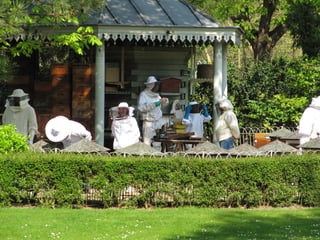
Both answers need beekeepers, and France has been making them since 1818, when the teaching began in the Jardin du Luxembourg in Paris with a diploma at the end of the course, on ground the Carthusian monks held before it. The course still runs. From 1856 Henri Hamet’s Société centrale d’apiculture used it to send instructors out to every department and to end étouffage (the killing of a colony to take its honey).
A hive that could not be opened was harvested by étouffage: the colony smothered or drowned, and the combs cut out
A hive made of a hollowed trunk or a straw basket had no way in, so the harvest and the colony could not be separated. The moveable frame is what changed that.
Hamet's society set out to replace the practice, and to spread the replacement by training instructors who would travel out from Paris to every department rather than waiting for beekeepers to come to them. The teaching was diploma-sanctioned from the start, and the Senate, which returned to the garden in 1879, kept the arrangement going by leasing the ground to each president of the society in turn.
The practice went on for nearly a century after the campaign against it began. It was finally prohibited by a law of 9 November 1942, inside a wartime food policy that also expanded apiaries, planned how much honey each beekeeper must deliver, and put beekeeping into the training of schoolteachers. At the Liberation the new authorities kept the measures, the ban among them.
Honeys France Is Known By
- Miel de lavande de Provence – the French honey sold abroad: in 2018 the American Specialty Food Association gave its gold award in the honey category to L’Abeille Occitane’s lavender honey from Provence.
- Miel de sapin des Vosges – dark honeydew gathered from aphids on the silver fir, malted rather than floral, and the oldest French honey name recognised in law: a Nancy court recognised Miel des Vosges-Montagne on 25 April 1952, forty-four years before it became Miel de sapin des Vosges.
- Miel de Corse - Mele di Corsica – named by season rather than by flower, six ranges running from the spring clementine groves to a maquis harvest taken as late as February, and only honey worked by the island’s own strain of the black bee on wild Corsican plants may carry the name.
- Miel de châtaignier – the honey of France’s chestnut country, where honey was long the only sugar on the table, and written into the rules of Corsica’s and the Cévennes’ designations and the Landes’ application; tannic and bitter, amber to dark amber in the jar.
- Myel ti poban – the honey of the mélipone, a stingless bee found only in Guadeloupe, which an order of 24 January 2020 placed under full protection: neither the bee nor its nests may be taken from the wild.
- Miel d’acacia – from the black locust, Robinia pseudoacacia, the flow French beekeepers move hives toward for a better-paid or a heavier harvest: in FranceAgriMer’s 2024 survey more than a quarter of those after a heavier crop went to acacia, and with chestnut it was the flow those after a better price sought most.
- Miel de baie rose – the honey Réunion’s beekeeping year is built around, out-producing every other flow in the island cooperative’s records through the 2000s, and made on a pink-peppercorn tree that has spread across the island’s ravines, abandoned farmland and old lava flows.
- Miel d’Alsace IGP – six honeys under one protected name since 2005, from all-flower to fir honeydew, on the one condition that the hives stand in the Bas-Rhin or the Haut-Rhin: the honey may be extracted and jarred outside the two departments, and a jar packed by anyone but the beekeeper must still show who kept the bees, by name, by beekeeper number or by a packer’s code.
- Miel des Cévennes IGP – the designation that writes lavender out: registered in 2015 for the Cévennes’ all-flower honey and its heather, chestnut, raspberry and bramble honeys, its rules bar the crops that are not the Cévennes’ own, sunflower, rapeseed, lucerne and lavender, and let them appear only as stray pollen.
- Miel de tilleul de Picardie IGP – the newest French honey designation, registered on 11 November 2025 and the first in the Hauts-de-France: a single-flower honey of the small-leaved lime that grows wild in the Picardy forests, pale straw with green glints and minty in its specification’s words, made from hive to harvest inside 1,481 communes, and proved by chestnut and bramble pollen as much as by the lime’s, since the lime sheds so little.
- Miel des Landes – a name whose reputation INAO dates to the nineteenth century at the latest, and a designation not yet granted: the application went to the European Commission in 2023, was published on 17 June 2026 with objections open until 17 September, and covers seven honeys of the sandy pine plateau from the pointe de Grave to Nérac, six single flowers from acacia to heather and one all-flower, proved by ten marker pollens of the uncultivated flora.
- Miel vert – Réunion’s honey of the tan rouge, Weinmannia tinctoria, a tree of the island’s wet mountain forests that grows nowhere but Réunion and Mauritius: Cordemoy’s flora of 1895 already called the honey its flowers give the island’s bee renowned, and it is still sold under that name.
- Miel de cueillette de Mayotte – honey taken from wild colonies in the forest, a practice the island’s people hand from one generation to the next and count as a marker of who they are, in Perichon’s 2024 ethnography; the bee is Apis mellifera unicolor, still seen there as a wild animal, and some thirty declared hive-keepers worked beside the gatherers in 2023.
- Miel de Narbonne – by the Ark of Taste’s account the most famous honey in France from the twelfth century to the twentieth, a honey of the garrigue, the low scrub of the Mediterranean limestone, in the maritime Corbières, led by rosemary and once taken a single time a year, at midsummer; the garrigue went under vines and Aleppo pine, and about thirty professional beekeepers in the Aude still make a little.
- Miel du Gâtinais – by the middle of the nineteenth century the honey Paris ate most, made on sainfoin, a fodder crop, graded from surfin down to commun and sold by the forty-kilo barrel; the sainfoin has all but gone from the fields, today’s miel du Gâtinais is an all-flower honey under the old name, and the honey museum at Château-Renard still grows the crop.
History and Tradition
In Charlemagne’s Capitulaire de Villis, beeswax is rated at the same value as honey, and the seigneurial acts of the Cévennes fold both into the cens (the annual due a tenant owed his lord). Keeping bees was a way of paying rent.
Through the early Middle Ages the forest was open to anyone, but from about 1200 the growth of towns and the trade in building timber led lords to reserve the woods and what came out of them. Under Louis IX the bigres were established across the kingdom: forest agents whose work was to find wild swarms, keep them, and bring in the honey and the wax on a lord’s account. The dues themselves survive in dated acts from the Vallée Française. A pound of wax in 1353. A carteron of honey, a capacity measure rather than a weight, in 1371. Half a pound of wax in 1504. And in 1488 a parcel called Ranc de Label, whose tenant paid the rent in honey, the name read as the ridge of the bee, abelha in Occitan.
What the wax was for was light. Beeswax candles burned slower than oil lamps, needed no tending and did not smell, and the candlemakers’ guilds policed them hard, forbidding any mixing with tallow or fat or pitch or resin. By the fifteenth century a proper wax candle was something only the nobility and the clergy could afford, and around 1760 one still cost half a day of a labourer’s work.
The hives themselves were made of whatever was to hand, and enough survive to be visited. In the Cévennes a hive was a hollowed chestnut trunk closed with a board and roofed with a slab of schist; seventeenth-century notaries called them brougnons de mouches à miel, and later brusc, from the Occitan rusc, bark. The first direct record of one is an agreement of 17 November 1627 between two men rebuilding a wall to enclose an apiary, the hives and the harvest to be shared equally. In Normandy and in Provence the hive went into the wall itself, in niches cut to its size, and those walls still stand. The largest known in France stands at Tessy-sur-Vire in the Manche, built of cob in the 1810s by Jean-Baptiste Gendrin, and Hubert Godefrey, who catalogued the bee walls of the Normandy bocage, ties the date to a shortage. Cane sugar had always been the costly import, competing at home with cheaper sugars of which honey was the chief one. Then Napoleon’s decrees of 1806 and 1807 closed Europe to British trade, Britain answered by forcing every ship bound for the continent through an English port, and neutral shipping stopped coming. French imports of raw sugar fell from twenty-five thousand tonnes in 1807 to two thousand the year after. Writing to his brother Louis, king of Holland, in March 1810, the Emperor saw no difficulty: it was a mistake to think France was suffering, since colonial goods were plentiful and le sirop de raisin et le miel suppléent partout au sucre. Grape syrup and honey were making up for sugar everywhere. Gendrin’s wall held a hundred hives. Thirty-four of its niches remain, and his family kept bees in it until the 1950s.
Both reasons for keeping bees were then taken away. Sugar extracted from beet arrived cheaply and in quantity, and honey stopped being how France sweetened its food. Households lit by electricity gave up the oil lamp and the wax candle together, and the ordinary candle became paraffin. When the state counted hives in the Lozère in 1943, it found 2,426 hollowed chestnut trunks against 694 modern frame hives.
Quality and Standards
Honey sold in France is defined by the EU honey directive as the product of Apis mellifera (the honeybee), with composition limits and rules on what a label may claim. Since 1 July 2022 the label on blended honey packed in France must name the countries the honey came from, largest share first; since 14 June 2026 the rule runs across the EU and the shares themselves are printed. The same 2026 decree abolished the category miel filtré (filtered honey): a honey stripped of its pollen may no longer be sold in France as honey.
Six French honeys hold a European designation, two as appellations of origin and four as protected geographical indications, each governed by a specification written by the producers themselves and verified by an independent body. An appellation of origin requires every step of the making inside its area, and a geographical indication at least one step there and a quality or reputation the place accounts for. A seventh, Miel des Landes, is before the European Commission, its French specification upheld at the Conseil d’État in March 2025 and its application published for objection on 17 June 2026.
Three islands are closed to imported bees by order, to hold their black bee, as the Corsican syndicate and the black-bee conservatories record it: Corsica since 1982, Belle-Île since 1985, and Ouessant since 1991, renewed in 2018.
Réunion is closed in both directions. By European Union order no live bee, no used hive equipment or wax and no comb honey for eating may leave the island for anywhere in the Union, the mainland included; by prefectoral order of 24 March 2016 none may be brought in, down to a passenger’s luggage. Honey in a jar may leave; honey in the comb may not. New Caledonia has barred imported bees since 1997 against the varroa mite, and bars them again from its main island to the Loyalty Islands and the Île des Pins, which have no American foulbrood.
Enforcement sits with the DGCCRF, the state’s consumer and fraud-control service, whose published categories of anomaly include mislabelled origin, forbidden claims, and faux-producteurs (beekeepers reselling bought-in honey alongside their own). For what the terms on any honey label mean in general, see the site’s guide to honey quality and labelling.
Specialty Retailers
- Les Compagnons du Miel / France Miel (Port-Lesney, Jura, 1958). A cooperative of professional beekeepers which, by its own account, had 233 members, one of them at Ayora in Spain, and about 56,000 hives in 2026 and packs between 6 and 10 per cent of the French crop under one name. Runs its own honey laboratory, founded 1968 inside its bottling plant, testing members’ honey for authenticity and origin in more than ten thousand analyses a year, and since 1988 doing the same for outsiders.
- La Maison du Miel (Paris, 1898). Founded, the house says, by Charles Galland, president of the French beekeepers’ union, to bring the regional honeys of France to the capital.
- Famille Mary (Maine-et-Loire, 1921). Begun with two hives at the Moulin de Beau Rivage in 1921 and a van to the La Baule market by 1936.
Competition Record
- Concours des miels de France 2025, Colza, or – Christelle Appéré, Les Ruchers du Léon (Plounévez-Lochrist, Finistère). A rapeseed honey taking gold in a judged national category.
- Concours des miels de France 2025, Colza, argent (silver) – Samuel Dubois, Les Ruchers des 3 Rivières (Arceau, Côte-d’Or).
- Concours des miels de France 2025, Sapin, or – Julien Frizon, L’Abeille de Lorraine (Yutz, Moselle).
- Concours des miels de France 2025, Châtaignier and Maquis, or – Colin Dupré (Calenzana, Haute-Corse), who also took coup de cœur (the class for honeys with too few entries to form a category of their own) in bruyère blanche (white heather) and in chêne (oak).
- Concours des miels de France 2025, Acacia, or – Julien Laffargue, Rucher de Claron (Bougue, Landes).
- Concours des miels de France 2025, Maquis, argent – Antoine Guidicelli, Maria Catalina (Santa Lucia di Mercurio, Haute-Corse).
- Concours des miels de France 2025, Maquis, bronze – Serge Cagninacci (Urtaca, Haute-Corse).
Illustrative Links
Links in other languages show a
 icon. Click the icon to open via Google Translate in a new tab -- close the tab to return. Click the link itself to visit the original site directly.
-
Le rucher du Jardin du Luxembourg – The Senate’s own history of the apiary in its garden, giving the 1818 date, the Carthusian inheritance, and the terms of the 1872 licence. (Sénat)
-
Miel de Corse - Mele di Corsica – The register entry for the Corsican appellation, with the pollen analysis that certifies origin and the link to the specification that names its six ranges. (INAO)
-
Le miel et l’apiculture – The ministry’s summary of national production, organic share and designations, on FranceAgriMer data. (Ministère de l’Agriculture)
-
Concours des miels de France – The national honey competition, its judged categories and its palmarès. (Union nationale de l’apiculture française)
-
Les apiculteurs habilités en AOP Miel de Corse – The Corsican syndicate’s own map, marking members who sell direct with a yellow bee and those whose honey reaches shops with an orange one. (Syndicat AOP Miel de Corse - Mele di Corsica)
-
Les miels – The regional agricultural office’s directory of Corsican AOP honey producers, grouped by micro-region. (ODARC / Gusti di Corsica)
-
Le projet de l’ACANB – The Ouessant black bee conservatory in its own words. (Association de conservation de l’abeille noire bretonne)
-
APIGUA – The Guadeloupe beekeepers’ association, which names the island’s endemic stingless bee. (APIGUA)
-
Miel et autres produits de la ruche – Réunion honeys carrying the national park’s mark. (Parc national de La Réunion)
See also
Further Reading
- Le Goût du miel – Michel Gonnet and Gabriel Vache (Éditions UNAF, 1985): Apidologie’s review of the field credits the Gonnet team with the first sensory analysis of honey, and the union whose competition and training network this page describes is what published it.
- Le Traité Rustica de l’apiculture – Henri Clément (Éditions Rustica, 2018): In print through three editions since 2002, directed by a Cévennes beekeeper who has also presided over the national union.
- Les miels : variétés, bienfaits, recettes – Patrick Chanaud (Édisud, 2010): A practical guide with sixty-three entries by honey type and seventy-five recipes, covering the French honeys this page names.
Sources
- FranceAgriMer (2024, 2025, 2026). Observatoire de la production de miel et de gelée royale, and Fiche filière apiculture.
- FranceAgriMer (2025). Fiche génétique apicole: biodiversité et territoire.
- DGCCRF (2023). Authenticité et qualité des miels: les anomalies restent nombreuses, results of the 2021 control plan, 6 October 2023.
- DGCCRF (2026). Réglementation sur les produits du petit déjeuner: une FAQ pour informer les professionnels, 16 June 2026.
- DGCCRF (2023). Enquête de la DGCCRF sur la francisation de miel: 50 000 euros d'amende et 6 mois de prison, communiqué, 6 October 2023.
- InterApi (2025). Estimation de la production de miel 2025, communiqué de presse, 18 November 2025.
- Union nationale de l'apiculture française (2025). Bilan de la récolte de miels 2025, 15 October 2025.
- Préfecture de La Réunion (2024). Détection de la loque américaine, maladie des abeilles, à La Réunion, communiqué, 27 March 2024.
- Boucher, S. (2019). Les particularités de l'apiculture guyanaise, Le Point Vétérinaire, 10 April 2019.
- European Commission (2005). Commission Regulation (EC) No 736/2005 of 13 May 2005, registration of Miel d'Alsace (PGI), OJ L 122, 14 May 2005.
- European Commission (2015). Regulation (EU) 2015/551 of 24 March 2015, registration of Miel des Cévennes (PGI).
- European Commission (2025). Commission Implementing Regulation (EU) 2025/2275 of 4 November 2025, registration of Miel de tilleul de Picardie (PGI), OJ L, 11 November 2025.
- European Commission (2026). Publication of an application for registration, Miel des Landes (PGI), PGI/FR/03002, OJ C/2026/3214, 17 June 2026.
- European Commission (2026). Geographical indications and quality schemes explained, Directorate-General for Agriculture and Rural Development.
- INAO (2025). Notice of the registration of Miel de tilleul de Picardie, 12 November 2025.
- ODG Miel d'Alsace (2023). Cahier des charges de l'IGP Miel d'Alsace, homologué par arrêté du 15 novembre 2023, BO-Agri n° 2023-48.
- Association Miels des Hauts-de-France (2024). Cahier des charges de l'IGP Miel de tilleul de Picardie, homologué par arrêté du 26 juin 2024, BO-Agri n° 2024-28.
- Groupement Qualité des Miels et des Produits de la Ruche du Languedoc-Roussillon (2015). Cahier des charges de l'IGP Miel des Cévennes, BO-Agri n° 16-2015.
- Direction des affaires vétérinaires, alimentaires et rurales de Nouvelle-Calédonie (2019). L'apiculture en Nouvelle-Calédonie, résultats de l'enquête 2019.
- Chambre d'agriculture de Nouvelle-Calédonie, CPA and SIVAP (2017). Réglementation en apiculture.
- Conservatoire botanique national de Mascarin (2026). Index de la flore vasculaire de la Réunion, Weinmannia tinctoria.
- Parc naturel régional du Gâtinais français (2026). L'homme au cœur du Parc, les apiculteurs.
- Île-de-France Terre de saveurs (2026). Miel du Gâtinais, product sheet.
- Musée vivant de l'apiculture gâtinaise (2026). Museum statements, Château-Renard.
- Slow Food Foundation for Biodiversity (2026). Ark of Taste, Miel de Narbonne, nominated by Patrick Malan.
- INAO (2026). Product register and cahiers des charges for the registered French honey designations, and the Label Rouge entries LA/24/89 Miel de lavande et de lavandin and LA/13/94 Miel toutes fleurs.
- INAO (2025). Une décision du Conseil d'État en faveur de la reconnaissance en IGP du Miel des Landes, news release.
- Council of the European Union (2001). Council Directive 2001/110/EC of 20 December 2001 relating to honey, as amended by Directive (EU) 2024/1438.
- République française (2003). Décret n° 2003-587 du 30 juin 2003 relatif au miel.
- République française (2022). Décret n° 2022-482 du 4 avril 2022 relatif au miel.
- République française (2026). Décret n° 2026-312 du 24 avril 2026 relatif au miel.
- République française (1942). Loi du 9 novembre 1942 relative à l'interdiction de la destruction des colonies d'abeilles par étouffage.
- Ministère de la Transition écologique et solidaire (2020). Arrêté du 24 janvier 2020 fixant la liste des insectes représentés dans le département de la Guadeloupe protégés sur l'ensemble du territoire national et les modalités de leur protection, JORF n° 0036 du 12 février 2020.
- Ministère de l'Alimentation, de l'Agriculture et de la Pêche (2009). Arrêté du 30 juillet 2009 relatif aux labels rouges LA 13/94 Miel de toutes fleurs et LA 24/89 Miel de lavande et de lavandin, JORF n° 0195 du 25 août 2009.
- Ministère de l'Agriculture (2026). Le Label rouge, signe de qualité supérieure.
- Sénat (online, undated). Dossier d'histoire, Une journée au Jardin du Luxembourg sous la Troisième République: le rucher.
- Société centrale d'apiculture (2026). Histoire du rucher du Jardin du Luxembourg.
- Jacob de Cordemoy, E. (1895). *Flore de l'île de la Réunion (phanérogames, cryptogames vasculaires, muscinées)*. Paris, p. 416.
- Perichon, S. (2024). L'abeille mellifère (Apis mellifera unicolor) à Mayotte: un insecte doué de sagesse et de vertu. *Revue d'ethnoécologie*, 25. https://doi.org/10.4000/12a67
- Lehébel-Péron, A., Travier, D., Renaux, A., Dounias, E., & Schatz, B. (2016). De la ruche-tronc à la ruche à cadres: ethnoécologie historique de l'apiculture en Cévennes. Revue d'ethnoécologie, 9. https://doi.org/10.4000/ethnoecologie.2531
- Fournier, J. (1999). Essais de fabrication de sucre de raisin sous le Premier Empire. Revue d'histoire de la pharmacie, 87(322), 227-234. https://doi.org/10.3406/pharm.1999.4742
- Godefrey, H. (2005). Des murs à abeilles dans le bocage normand. Abeilles & Cie, 109.
- Napoléon Ier (1866). Correspondance de Napoléon Ier, t. 20, n° 16352, à Louis Napoléon, roi de Hollande, 20 mars 1810. Imprimerie impériale, pp. 318-320.
- Esnault, O., Sinelle, J., Bègue, H., Lesquin, S., Reynaud, B., & Delatte, H. (2014). Caractérisation de l'apiculture réunionnaise: chiffres-clés, pratiques et typologie. La Santé de l'Abeille, 262.
- Wragg, D., Techer, M. A., et al. (2018). Autosomal and mitochondrial adaptation following admixture: a case study on the honeybees of Reunion Island. Genome Biology and Evolution, 10(1), 220-238. https://doi.org/10.1093/gbe/evx247
- Champenois (2011). Première approche de la méliponiculture et des mélipones en Guyane, 123 pp.
- Syndicat des miels des Landes (2023). Cahier des charges de l'IGP Miel des Landes, homologué par arrêté du 17 août 2023.
- Syndicat des miels des Landes (2026). Cahier des charges de l'IGP Miel des Landes, version juin 2025, approuvé par le comité national de l'INAO le 26 janvier 2026.
- Syndicat AOP Miel de Corse - Mele di Corsica (2026). Dossier de presse, on the 1982 closure of the island to imported bees.
- Fédération des conservatoires de l'abeille noire (2026). Conservatoire pages for Ouessant and Belle-Île.
- Association des apiculteurs de la Guadeloupe, APIGUA (2025). Plantes mellifères de Guadeloupe, tome 1.
- Specialty Food Association (2018). sofi Awards, Gold, Honey: The French Farm's L'Abeille Occitane Pure Lavender Honey.
- Fortnum & Mason (2026). French Lavender Honey, 500g, product listing.
- Zingerman's Mail Order (2026). Lavender Honey from Provence, product listing.
- Union nationale de l'apiculture française (2025). Concours des Miels de France 2025, palmarès.
- Les Compagnons du Miel (2026). Notre coopérative and Notre laboratoire d'expertise, cooperative statements, Port-Lesney.
- La Maison du Miel (2026). Company history statements, Paris.
- La Maison du Miel (2026). Charte qualité, Paris.
- Hedène (2026). Nos miels, product catalogue, Paris.
- Syndicat National d'Apiculture (2026). Grande Fête nationale des miels de France du 23 au 27 septembre 2026.
- APIGUA (2026). Caractérisation sensorielle des miels de Guadeloupe, 9 April 2026.
- Famille Mary (2026). Notre histoire, company statement, Maine-et-Loire.
- La Borda d'Ambrosi (2026). Le retour des miels de crus rares, blog post, Sillas.