
Renge Honey (レンゲ蜜)
The Story
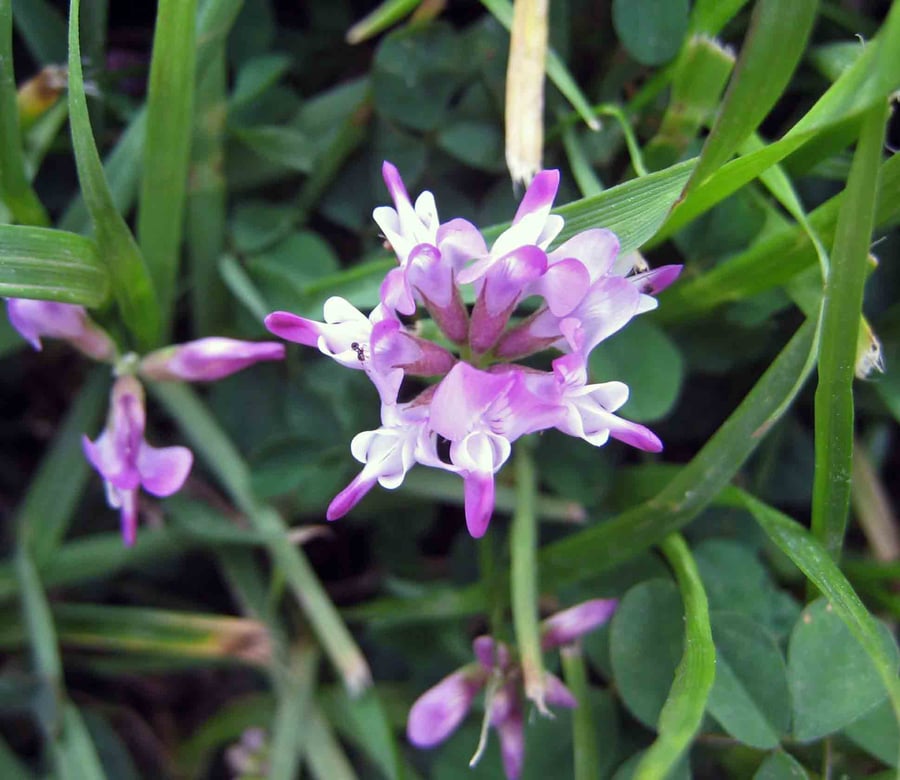
The plant that produces renge honey is grown to be destroyed. Astragalus sinicus is planted across Japan’s rice paddies each autumn as a green manure crop, fixes atmospheric nitrogen through winter, blooms for two to three weeks in April, and is plowed under before the rice seedlings go in. The beekeeper works inside that window or not at all.
The honey that comes from that window has a name in Japan: hachimitsu no osama, the king of honey. The title refers to the flavor – full, clean, and rounded – and to the position renge once held at the center of Japanese domestic beekeeping. Every major rice-growing prefecture had renge fields. The season moved north through April, Kyushu first, then the Honshu rice belt.
Plantings fell 81 percent between 1985 and 2018. Synthetic nitrogen fertilizers made the cover crop economically redundant. Rural labor left for the cities. A bag of fertilizer did what the fields had done, without the timing, the birds, or the bees. What remains is scattered: Gifu Prefecture in central Japan, parts of Kyushu. Dorato sources its renge from Gifu and lists it among the most valued domestic honeys it carries. Renge still accounts for roughly 15 percent of Japan’s domestic honey production – the third most common type after multifloral and acacia. That position comes after an 81 percent reduction in the fields that produce it.
Characteristics
A pale gold honey that sets to fine white cream. Dorato’s description – toyokana fuumi, rich and abundant flavor – is accurate in the sense that the flavor is full without being assertive. It does not have the mineral edge of buckwheat or the floral lift of acacia. Its authority is completeness: a clean sweetness with enough depth to hold across cooking, tea, and eating directly. Sugi Bee Garden, Japan’s largest beekeeping enterprise, confirms the characteristically clear color from Kumamoto production. Crystallization is relatively fast for a Japanese monofloral, consistent with the legume-derived sugar profile – the crystallized form is a fine, pale cream that does not separate or become grainy.
Click to Display — The Details: botanical origin, sensory profile, pairings, health and what gives it its character
Botanical Name: Astragalus sinicus
Botanical Family: Fabaceae
Bee Species:
Apis mellifera, the Western honeybee, introduced to Japan in 1877 and the commercial standard within a generation. Sugi Bee Garden runs one of Japan’s largest Apis mellifera operations and produces renge from Kumamoto as the first honey of its annual migration. Apis cerana japonica, the Nihon mitsubachi, also forages renge, but its harvest is a once-yearly autumn extraction of hyakkamitsu – hundred-flower honey accumulated across the full season. Renge is one component of that accumulation. It cannot be isolated.
Color:
Pale gold to light amber, clear. Sugi Bee Garden, which harvests renge across Kumamoto Prefecture, describes the color as characteristically clear. Sets to fine white cream on crystallization.
Flavor Profile:
Full, clean, and rounded. No resinous edge, no floral assertiveness. Rich without weight. Dorato describes it as toyokana fuumi, a rich and abundant flavor.
Tasting Notes:
The honey sets to a pale, fine-grained cream that does not separate easily. Eaten from the spoon, the sweetness arrives clean and holds without developing into something heavier or sharper. There is no bitter finish, no resinous note, no floral peak that subsides. The flavor is consistent from entry to aftertaste. Compared to acacia – which Dorato describes as sukkiri, clean and without distinctive character – renge has more body. Compared to buckwheat or soba, it has no mineral edge. The uniformity is what the king of honey designation points at: a complete flavor that does not make demands. The crystallized form behaves similarly – the fine grain does not interrupt the clean finish. Dorato pairs it with bread and pancakes, which require a honey that does not dominate.
Aroma:
Light floral, spring character. Understated.
Defining Compounds:
Compound research on Astragalus sinicus honey has been conducted primarily on Chinese ziyunying production, which uses the same plant species. Six compounds showed high odor activity values in GC-O-MS analysis. Ethyl 3-phenylpropionate was identified in this honey type for the first time in that research and contributes a mild sweet-floral character consistent with the honey’s overall profile. Total flavonoid and phenolic content is relatively high compared to other light-colored honeys, contributing to the antioxidant activity documented in the same studies. The flavonoid content is notable because pale-colored legume honeys are not typically associated with high polyphenol levels. Compound research specific to Japanese renge production has not been published in accessible form; the Chinese ziyunying data is the best available proxy for the same plant.
Forage Origin:
Astragalus sinicus is a winter annual legume in the pea family, planted across East Asian rice paddies for approximately two thousand years as a biological nitrogen source. The root nodules, colonized by Rhizobium huakuii bacteria, fix atmospheric nitrogen directly into the soil. At scale, this made renge the primary soil amendment for Japanese rice agriculture – cheaper than manure, lighter to transport, effective by the time the rice went in.
The flowers are pink to purple-pink and bloom in dense carpets across the paddy surface. The name renge means lotus flower in Japanese. The plant takes that name from the shape of the flower head, not from any botanical relationship to lotus. In western Japan, the same plant is often called genge (げんげ), a variant name that appears in haiku and poetry traditions.
One disambiguation matters. Astragalus sinicus is the honey plant. Astragalus mongholicus is the medicinal plant – the source of Radix Astragali, huang qi, used in Chinese traditional medicine. Both carry the common English name milkvetch. They are different species. The root of A. mongholicus is what the medicine uses. The flower of A. sinicus is what the bees work.
Pairings:
Toast and pancakes, per Dorato. Plain yogurt, where the clean sweetness does not overwhelm. Eating it directly, which is how Dorato recommends encountering it first – the flavor does not need a foil. Morinaga Seika has produced a renge honey amazake, pairing renge with the fermented rice drink that is itself a Japanese cold-season staple. The combination works because both carry a mild, rounded sweetness without sharp botanical interference. Coffee and black tea. Light Japanese green teas – gyokuro or a first-flush sencha – where the honey’s clarity does not compete with the tea’s vegetal notes. Cooking applications where a mild, clean sweetness is required without strong botanical interference. The king of honey designation reflects versatility as much as flavor: a honey that fits most contexts without redirecting them.
Health Uses:
Regarded in Japan as a gentle everyday honey suited to broad household use. Sugi Bee Garden notes that their renge honey has many loyal fans who look forward to its arrival each spring – a loyalty built on flavor and consistency rather than specific health claims. The king of honey designation is a flavor judgment, not a therapeutic one. No specific medicinal claims are made or documented for renge honey distinct from honey in general.
Origin Story
Astragalus sinicus entered East Asian agriculture approximately two thousand years ago, spreading with rice cultivation across Japan, China, and Korea. Its role was fixed: nitrogen for the soil, bloom for the spring, then destruction. The agricultural calendar used it and moved on. Beekeeping arrived later.
Western beekeeping reached Japan in 1877 with the Meiji government’s deliberate importation of Apis mellifera and the Langstroth hive. It found renge waiting. The plant that had fixed nitrogen for rice farmers for two millennia now anchored the first significant commercial nectar flow of the Japanese beekeeping year. The timing was structural: renge bloomed before anything else of consequence, which made it the foundation of the spring season rather than one crop among several.
The postwar period was renge honey’s peak. Japan’s rice production expanded through the 1950s and 1960s, and renge acreage expanded with it. Beekeepers following the front northward each April were working at the intersection of two major agricultural systems simultaneously. The honey this produced was mild, reliable, and abundant enough to enter ordinary Japanese households. The king of honey designation entered common use during this period.
The reversal came from the same modernization that built the peak. Ammonium nitrate and urea fertilizers became cheap and available through the late 1960s. A beekeeper’s most valuable spring was also a rice farmer’s most labor-intensive month. Renge required seeding in autumn, management through winter, and precise timing in spring. A bag of synthetic nitrogen required none of this. Planting began to fall. The rural workforce that had seeded, tended, and timed the crop moved to the cities. The two forces compounded each other through the 1970s and 1980s, and the 1985-to-2018 MAFF measurement caught the tail of a decline that had already been underway for twenty years.
What Dorato now calls a precious domestic honey was once the foundation of the Japanese spring beekeeping season. That is the distance the honey has traveled.
Cultural Context
Renge-so is embedded in Japanese poetry at a level most plants never reach. Genge (げんげ), the western Japan variant name for the same plant, is a kigo for mid-spring in the traditional Japanese poetic calendar. Genge maku – sowing milk vetch – is a kigo for late autumn. The plant marks both the moment it is planted and the moment it blooms in the same poetic tradition. A Japanese poet writing either word needed no further explanation. The entire paddy landscape came with it.
Seishi Yamaguchi, one of the most significant haiku poets of twentieth- century Japan, wrote specifically about genge fields. His 1972 haiku identifies Mino Province not as a place that contains milk vetch fields but as a place that is milk vetch fields:
there you have the land of Mino.
Trans. Takashi Kodaira & Alfred H. Marks
The Essence of Modern Haiku · Mangajin / Weatherhill, 1993
The province Yamaguchi identified as milk vetch country is exactly where Dorato sources its renge today. The poet documented the fields in 1972. The retailer finds the last of them half a century later.
In 1997 the Japanese postal service issued a definitive stamp in the Nature of Japan series pairing the Nihon mitsubachi with rengeso – the native bee and its spring flower together as a national image. The honey plant and the endemic bee received official recognition as a single ecological unit.
Renge-so was also a childhood plant. The stems are hollow, the flowers easily detached. Children threaded them into chains and wore them as crowns at the paddy margins before the farmers arrived with the plow. Accounts from elderly Japanese respondents describe the plant first as a visual – the pink carpet across the fields – before anything botanical. A woman from Nara recalled spending hours as a child in the renge field near her house, making garlands and lying down among the flowers. That memory is now largely historical. The fields are gone. A generation that played in them is elderly. The honey connected to that memory sits differently in the market than a honey without one. Dorato lists renge with the notation that the fields decrease year by year. That is as close as a product listing gets to an elegy.
Renge’s commercial position today: the third most common domestic honey type by volume after multifloral and acacia, at roughly 15 percent of domestic production. This after an 81 percent reduction in plantings. The honey did not disappear. The scale did.
Harvest & Forage
Two to three weeks in April. The renge bloom advances from south to north with latitude – Kyushu in late March, the main Honshu rice belt through April – and ends when the farmer plows the field. That timing is set by the rice calendar, not the beekeeper’s preference. Hives go in before the bloom. Extraction happens immediately after. There is no second pass.
Sugi Bee Garden, whose annual 2,400-kilometer migration begins with the renge harvest in Kumamoto each April, describes the 2024 renge season as beginning in mid-April. The honey comes out of the comb clearly – the color is the first visible confirmation of the source. The fields are plowed under shortly after. The operation then moves north toward Akita and eventually Hokkaido.
When renge fields were widespread this was a logistics problem. Now it is a supply problem. Finding enough renge acreage to justify positioning hives for a monofloral harvest is the primary constraint. Production survives where fields survive: parts of Kyushu, Gifu Prefecture in central Japan. The 81 percent reduction in plantings between 1985 and 2018 removed the infrastructure the honey depended on.
Beekeeping Context
Renge honey is the first honey of Japan’s commercial beekeeping season. Sugi Bee Garden, Japan’s largest beekeeping enterprise, begins its annual 2,400-kilometer north-to-south migration in Kumamoto Prefecture with the renge harvest each April. The bees arrive before the bloom, work the paddy fields, and the honey is extracted before the farmers plow. Then the operation loads hives onto trucks and heads north – to Akita in June, then Hokkaido through summer and autumn for acacia, linden, buckwheat, and whatever the northern season provides. Renge is where the year opens.
That opening requires fields. With 81 percent of Japan’s renge plantings gone, the operational pattern has changed from migration to prospecting. Beekeepers who produce renge honey now maintain relationships with specific farmers on specific surviving fields: the Kumamoto operations that Sugi Bee Garden depends on, the Gifu Prefecture producers that Dorato works with. The honey that results is artisan by default, not by design – small volumes, documented provenance, sourced from what survives.
Source Regions
- Astragalus sinicus - 대한민국 (South Korea) - 전라도·Jeolla region: Known in Korea as jaeunyeong kkul (자운영꿀). Produced from rice paddy milk vetch in the southwest Korean agricultural region. Documented in Korean beekeeping literature as a recognized monofloral type.
Regional Variants
- Renge honey - Astragalus sinicus - Japan - 熊本県·Kumamoto: Commercial expression. Characteristically clear pale gold. Large-scale migratory production by Sugi Bee Garden opening its annual 2,400km season. Most available Japanese renge in domestic retail.
- Renge honey - Astragalus sinicus - Japan - 岐阜県·Gifu (former Mino Province): Artisan expression. Toyokana fuumi – rich and abundant flavor per Dorato. Small volume, documented field-level provenance. Fields decrease year by year.
- Ziyunying honey - Astragalus sinicus - 中国 (China) - 長江流域·Yangtze River provinces: Longer bloom window (February to June) than Japan. Commercial scale across multiple provinces. The expression on which all compound research cited on this page was conducted.
Translations
- Renge-mitsu or renge-so-no-mitsu (Japanese)
- Also genge (げんげ) in western Japan dialects and haiku tradition; genge appears in traditional saijiki as a mid-spring kigo
- Genge maku (sowing milk vetch) is a kigo for late autumn – the same plant marks both seasons in the haiku calendar
- Chinese milk vetch is the standard English botanical name
- Not to be confused with Astragalus mongholicus honey, the source of Radix Astragali, sometimes also sold under the milkvetch name
Festivals and Fairs
- Honey of the Year / Hachimitsu Festa – Ginza Kami Parupu Kaikan, Tokyo. Held annually in late July or August 3 (Japan Honey Day). The national competition where domestic spring honeys including renge compete alongside approximately 100 honeys from Japan and overseas. The domestic Western bee division is where renge entries are judged. Organized by the Japan Honey Meister Association.
Further Reading
- The Essence of Modern Haiku: 300 Poems by Seishi Yamaguchi – Yamaguchi Seishi, trans. Takashi Kodaira and Alfred H. Marks (Mangajin/Weatherhill, 1993): Contains two haiku specifically about genge (milk vetch) fields, including a 1972 poem identifying Mino Province – modern Gifu Prefecture, where Dorato sources its renge – as a landscape defined by milk vetch cultivation.