
Honey Ants
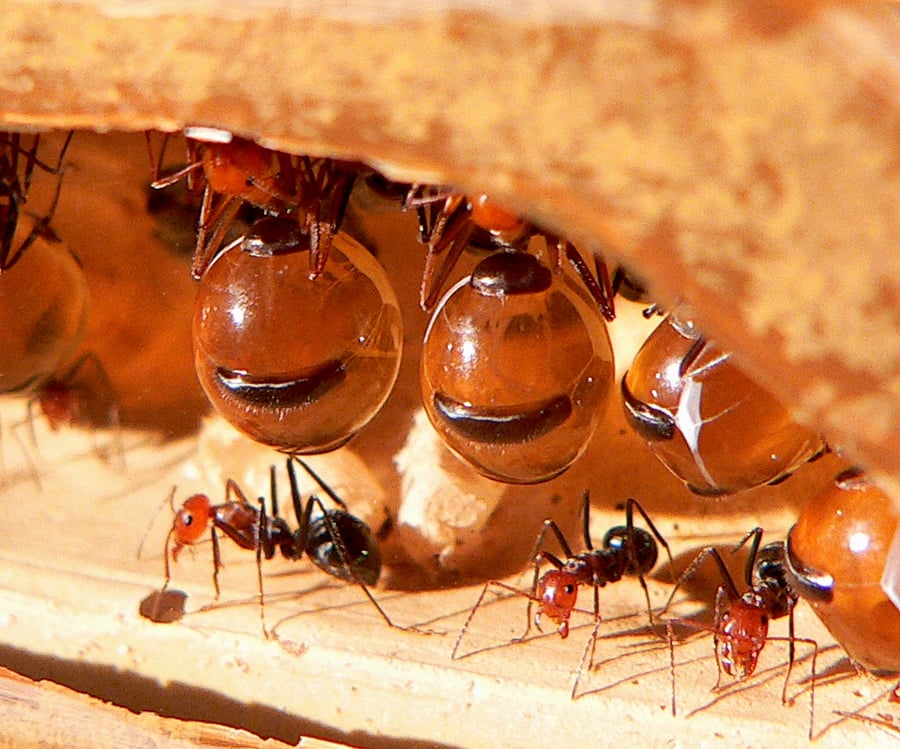
Some ants keep honey, and they keep it without a comb. In the deserts where they live, certain workers in the colony are fed and re-fed by the others until they can no longer move, their abdomens swelling with stored liquid into translucent ambers the size of a small grape. These workers, called repletes, hang motionless from the ceilings of underground chambers and serve as a living pantry, regurgitating their store to feed the colony through the dry months when nothing flowers. To take the honey, a person has to find the nest and dig.
The Ant and Its Honey
The swelling has a name, physogastry, and the strategy behind it is simple: in country where sweetness comes only in pulses, after rain or a brief flowering, the colony stores the surplus in the one container always to hand, the bodies of its own members. A replete can hold so much that the soft membrane between its abdominal plates stretches tight and clear, and it cannot right itself if it falls.
What the repletes hold is honey-like, but it reaches them by a path that has nothing to do with flowers in the way a bee’s does. The foraging workers gather nectar from glands that some desert plants carry outside their flowers, honeydew from sap-sucking insects, and the sugary exudates of galls; they carry it home in their bodies and pass it, mouth to mouth, to the repletes, who concentrate and hold it. The result is a store of sugar built by an insect, from plants, without a hive and without wax.
This is a different answer to the same problem the honeybee solves. Honeypot ants are not one kind of ant but a strategy that has appeared independently in several unrelated genera in deserts around the world, the genus Camponotus in Australia and Myrmecocystus across the Americas chief among them. The two lineages are separated by tens of millions of years and never shared the trait by inheritance; each arrived at the living-larder caste on its own, shaped by the same arid pressure. Where the ants occur and where deserts are old, people have tended to find them.
A Food Found Three Times Over
Three regions of the world hold a documented tradition of digging honey ants for food, and they map onto the deserts where the ants are richest: central and western Australia, central and northern Mexico, and the arid southwest of the United States.
In Australia, the ant is Camponotus inflatus, known by a different name to each people who harvests it: yarumpa to the Arrernte, yurrampi to the Warlpiri, tjaḻa to the Aṉangu of the country around Uluṟu. The harvest is traditionally women’s work, undertaken in groups and often with children along. The surface gives little away; the diggers read it for the faint vertical shafts that mark a colony, then follow a shaft down, sometimes two metres, to the chambers where the repletes hang. The honey is taken by holding a replete and pressing the bead of honey onto the tongue, or by eating the swollen ant whole. Only part of a nest is worked, and the colony is left to recover. The Aṉangu place the ant within a category of sweet foods they call tjuratja, which also takes in the nectar of the honey grevillea; the Arrernte word for the same class of foods is ngkwarle, “honey-like foods.” Across the desert the honey was also medicine, taken for sore throats and colds and put on cuts to hold off infection.
In Mexico, the honey ant is a species of Myrmecocystus, and the tradition runs back to before the Spanish arrived. The Aztecs ate the repletes and called them necuazcatl, “honey ant.” The repletes were dug from their nests, the head and thorax sometimes pinched off so the captured ants could not rupture one another, and the honey-filled abdomens eaten fresh or pressed for their honey. That honey was used as food and as medicine, applied for eye complaints and taken for fever, and it was also fermented into an alcoholic drink, a use the Australian tradition does not record. Repletes were traded, and as late as the 1880s a visitor described them sold by the spoonful, fastened to squares of paper, in the markets of Mexico City.
In the southwestern United States, Indigenous peoples of the Sonoran and Californian deserts gathered honey ants of the genus Myrmecocystus, among them Myrmecocystus testaceus. The record here is chiefly one of food and remedy rather than ceremony: a survey of Indigenous Californian practice documents the eating of honey ants across many groups, and nineteenth-century accounts from New Mexico describe a sweet drink made by dissolving the honey in water, taken in the mountains for fever where no doctor could be reached.
Honeypot ants live in arid parts of Africa as well, but no comparable tradition of gathering them for food has been documented there.
The Sweetness That Became a Dreaming
In Australia the honey ant is more than a food, and its meaning runs deeper there than anywhere else the ant is known. Across the Western Desert it is a Dreaming, an ancestral presence written into the land and into Tjukurrpa, the law and cosmology that binds people to country. At Papunya, the community northwest of Alice Springs, three low hills are understood to be the body of a giant ancestral Honey Ant, and the place takes its name from a honey-ant story shared, unusually, across many language groups. The interlocking tunnels and chambers of a real colony stand, in this understanding, for the unseen connections of songline and kinship that join one place to another across an unbounded land.
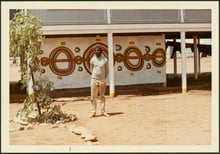
It was at Papunya, in 1971, that senior men painted a Honey Ant Dreaming on the wall of the school. That mural is now widely regarded as the spark of the Western Desert Art Movement, the painting tradition that carried Aboriginal art into galleries around the world. The honey ant sits, in other words, at the root of one of the twentieth century’s major art movements. Its image recurs through the work of the early Papunya painters, and the deeper, ceremonial layers of those designs remain restricted knowledge, shown only in part.
What the Honey Is Like
By the measures used for ordinary honey, ant honey is a near relative with its own character. The one detailed laboratory study, on ants collected in the Goldfields of Western Australia, found it runnier and less sweet than bee honey, with a notably higher water content, around a third, against the tenth or so typical of bee honey, and a distinctly acidic taste. Its sugars are the familiar glucose and fructose. It would not meet the international standard written for the bee product, not because anything is wrong with it but because that standard was never written with an ant in mind.
The old medicinal use has lately drawn scientific attention. A 2023 study from the University of Sydney found honey from Camponotus inflatus active against Staphylococcus aureus and against fungi including Cryptococcus and Aspergillus, by a mechanism unlike that of mānuka or jarrah honey. Danny Ulrich, of the Tjupan language group, whose family runs honey-ant tours in the Goldfields, helped the researchers find a nest at the base of a mulga tree; the practice his ancestors followed, he notes, has always been to take only what is needed and leave the colony enough to recover.
The honeybee builds a comb of wax and fills it; the honey ant fills the bodies of its own. Two lineages that have not shared an ancestor in tens of millions of years each met a season when sweetness runs short, and answered it the same way, by concentrating the sugar of plants into a keepable store, yet arrived at two entirely different vessels for holding it.