
Indonesia Honey
Jump to Regional Travel and Honey Pages

Indonesia is the world’s largest archipelago: 17,000 islands spanning a distance greater than the continental United States, straddling the equator between two oceans, holding the third-largest tropical forest on earth. The honeys those forests produce are unlike anything that reaches the international market, and the reason is structural. The dominant species, Apis dorsata, builds open nests in the crowns of emergent trees, absconds when disturbed, and will not tolerate a box. Every gram arrives by a climber from a wild colony. Indonesia tracked 18,430 liters of forest honey in 2024 while its people consumed somewhere between 7,000 and 15,000 tons the same year – importing the rest from Thailand, Argentina, and Vietnam. The forests hold far more than the market has learned to reach.
Indonesia holds five wild honeybee species. Beyond Apis dorsata, Apis cerana nests in cavities and yields to box management but produces far less per colony. Apis florea, the dwarf honey bee – called tawon lanceng in Java – occupies exposed low nests and produces small quantities. The stingless bees of the Meliponini tribe, collectively kelulut or klanceng by region, produce the sour, resin-inflected madu kelulut now growing as a commercial category under pesantren cultivation programs. Apis mellifera, introduced by Dutch colonial agents in 1841, runs the managed commercial farms. The production ceiling exists because the species with the highest yield per colony – Apis dorsata – is the one that cannot be farmed.
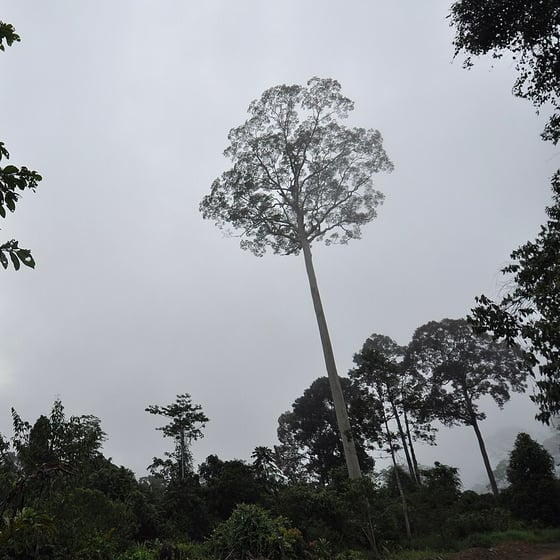
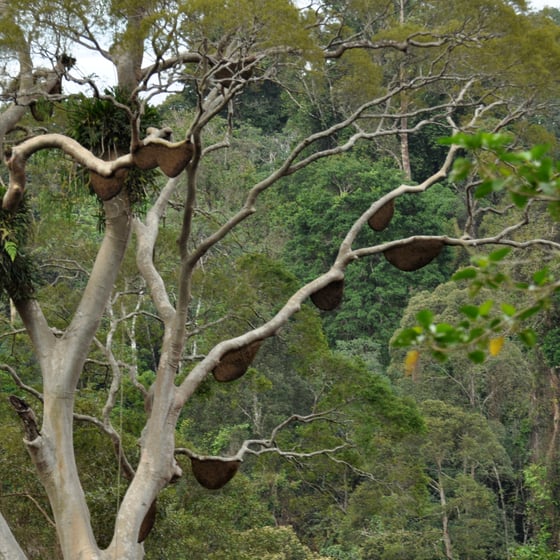
Indonesia has no single dominant forage plant at the national level. Each island system generates its own honey identity from its own forest. In Riau and Kalimantan the sialang tree (Koompassia excelsa) serves as both the preferred nesting site of Apis dorsata – its smooth, soaring trunk reaching 88 meters deters predators – and a protected species under the adat tenure systems of communities like the Petalangan, who prohibit felling it as long as bees nest there. In Bangka Tengah the pelawan (Tristaniopsis merguensis), a tree entirely absent from Java, produces a bitter nectar that gives Madu Pelawan its flavor and, increasingly, its legal identity: the village of Namang was pursuing geographic indication registration for Madu Pelawan with DJKI and JICA support as of July 2024, the first named forest honey origin in Indonesia to do so. In Danau Sentarum the annual flood-and-flower cycle of a 132,000-hectare freshwater wetland drives a honey calendar tied to the sequential blooming of putat, emasung, and taun. In Java the kapuk randu (Ceiba pentandra), once the dominant commercial forage plant for Apis mellifera hives, has declined to roughly eleven percent of its former cultivated area since the 1980s as land use shifted – the single largest structural change to the commercial honey industry in the country’s recent history.
The harvest traditions that have grown around Apis dorsata reach well beyond informal practice. The menumbai ceremony of the Petalangan people of Riau, declared a national intangible cultural heritage, requires a specialist – the juagan tuo – who addresses the colony in pantun verse before cutting into the comb. Parallel systems operate across Kalimantan, Aceh, and Nusa Tenggara Timur, each with named roles, tools, and prohibitions. These traditions function as governance systems: setting harvest timing, preventing overharvesting, and maintaining the relationship with the colony that makes next season’s harvest possible.
The ceremony performed in darkness without protective gear, and four other traditions governing the harvest
The menumbai ceremony is performed at night, in complete darkness, without modern protective gear. The juagan tuo addresses the colony in alternating pantun verse before cutting into the comb, personifying the bees as a beautiful girl and asking her permission. The specific pantun text, the specialist title, and the dedicated tools -- tunam, timbo, ubo, semangket -- were documented in full in Indonesiana Vol. 14 (Kementerian Pendidikan dan Kebudayaan). The named specialist role and the oral literature that transmits it are internal evidence of centuries of continuous practice.
The muar ceremony of Ketapang, Kalimantan Barat, uses a bamboo ladder called jatak and a spoken prayer for safety -- timang madu -- as the harvester descends from the colony. In Aceh the BPNB documented the Buloh Seuma community's relationship with the reubek tree and its colonies in a 2022 monograph, framing the harvest as a system of obligations to a forest understood to hold power the harvester must acknowledge. In Nusa Tenggara Timur the Bijoba Sonav poem in the Dhawan language records bee abundance as a sign of regional prosperity; the Dhawan practice includes a ritual call to invite bees to inhabit trees before the harvest begins.
The prohibitions embedded in these traditions -- on when trees may be felled, which colonies may be harvested, what portion must remain -- are the operational mechanisms that prevent colonies from absconding and ensure a viable harvest the following season. The adat tenure systems protecting sialang trees in Riau and Kalimantan almost certainly predate the colonial period.
Honey also sits inside an Islamic health framework. Honey’s grounding in Surah An-Nahl – created by divine instruction to the bee – makes it a cornerstone of Thibbun Nabawi, the Prophetic medicine tradition organizing health practice for many Indonesian Muslim families. Stingless bee cultivation has also become a development model for the approximately 26,000 pesantren across Indonesia.
The three boarding schools chosen because they adjoin protected forest, and the hives Bank Indonesia has sent since
In December 2021 the Faculty of Engineering at Universitas Indonesia described a stingless bee program it had installed at three pondok pesantren as national demonstration centres: Nurul Qur'an in Bengkulu, Alam Indonesia in Sulawesi Selatan, and Al-Kahfi in Kabupaten Sumbawa, Nusa Tenggara Barat. The faculty states that the cultivation technology was developed with funding from Bank Indonesia, and that the three schools were chosen because each adjoins protected forest, which it calls their comparative advantage. The team leader, Muhamad Sahlan, described the aim as kemandirian pesantren -- boarding school self-reliance -- and gave practical reasons for choosing these bees: they are easy to keep, they breed alongside people, and the honey has high economic value.
Bank Indonesia's provincial offices have since supplied colonies directly. Its Bengkulu office and the provincial Ministry of Religious Affairs handed starter trigona colonies to fifty pesantren at the 2023 Festival Syariah. Its Kalimantan Barat office delivered a hundred hives to Pondok Pesantren Muinul Islam at Kubu Raya in December 2022, together with forage plants, post-harvest equipment, and help through business licensing and halal certification.
The documentation and market infrastructure for Indonesian forest honey concentrates around two institutions. JMHI (Jaringan Madu Hutan Indonesia), with its national secretariat at Yayasan Riak Bumi in Pontianak, has built traceable supply chains for Apis dorsata producers across the archipelago since 2000. Desa Namang in Bangka Tengah is the other significant pole: a village that enacted its own forest protection regulation in 2008 and was working toward a geographic indication for Madu Pelawan Namang in 2024.
The 2007 certification that made Danau Sentarum the first organic-certified forest honey in Indonesia
In 2007 the APDS cooperative (Asosiasi Periau Danau Sentarum) in Kapuas Hulu received BIOCert organic certification -- the first ever issued to an Indonesian forest honey producer. The certification was presented at a Ministry of Forestry ceremony by the minister himself. The 28,000-hectare periau (honey forest) under APDS management represents the most documented community-managed forest honey system in the country.
Desa Namang enacted its own Perdes protecting the Hutan Pelawan in 2008, received the Adi Karya Pangan Nusantara award in 2013, and was working with Kemenkumham and JICA toward a geographic indication for Madu Pelawan Namang in 2024 -- the first named forest honey origin in Indonesia to pursue formal geographic protection. The JICA technical assistance was coordinated through Kanwil Kemenkumham Kepulauan Bangka Belitung.
Tap or click a region to explore its honey. Map data: superpikar/indonesia-geojson (MIT).
Honeys Indonesia Is Known By
- Madu Hutan Danau Sentarum – wild Apis dorsata honey from the flooded lake forest of Kapuas Hulu, worked from tikung, tembesu planks hung in the canopy for wild colonies to build on and held tree by tree under family tenure by Iban and Malay periau groups; Dutch officials recorded the trade in these lakes as early as 1823.
- Madu Sialang – the honey of the sialang trees on Petalangan customary land in Pelalawan, Riau, cut from wild Apis dorsata combs at night by a juagan tuo who chants pantun as he climbs; the practice, menumbai, was listed among Indonesia’s intangible cultural heritage in 2015.
- Madu Hutan Sumbawa – wild Apis dorsata honey from Sumbawa’s forests, thick because the island’s long dry season leaves little moisture in the nectar, and the first Indonesian honey whose name was registered to its own harvesters, so that only honey from the island can carry it.
- Madu Pelawan Namang – bitter honey from the pelawan tree, Tristaniopsis merguensis, which flowers once a year in a village-protected forest at Desa Namang on Bangka where wild Apis dorsata build in its canopy; its name is on the national origin register, so only honey from that forest can carry it.
- Madu Teran Belitong Timur – from the stingless bee Heterotrigona itama, farmed across Belitung Timur and sold in three grades by colour, from yellow through brown to near-black; one of only three honeys on Indonesia’s origin register.
- Madu Randu – kapok honey, from the flowers of Ceiba pentandra, the crop that opens Java’s honey year: hives are trucked to the kapok stands around Pati, Jepara and Batang, then moved on to rubber and afterwards to longan.
History and Tradition
Wild honey harvest in Indonesia predates any written record. The menumbai ceremony of the Petalangan people of Riau, the muar tradition of Ketapang, and the reubek tree practices of Buloh Seuma in Aceh each carry internal evidence of centuries of continuous practice – specialist role names, dedicated tools, oral literature, and governance systems that take generations to develop. The adat tenure systems protecting sialang trees (Koompassia excelsa) in Riau and Kalimantan function as de facto conservation law and almost certainly predate the colonial period.
Formal beekeeping arrived with the Dutch. In 1841 Rijkeus, a Dutch colonial agent, introduced Apis mellifera to Java – the first managed commercial bee in Indonesia. For a century the commercial industry remained a colonial and post-colonial overlay on top of a far older wild harvest culture. The two systems operated largely independently: managed Apis mellifera farms on Java and Sumatra, wild Apis dorsata harvest across the archipelago.
The contemporary period begins in 2000, when Yayasan Riak Bumi in Pontianak established JMHI (Jaringan Madu Hutan Indonesia) as the first national network dedicated to giving wild forest honey producers traceable supply chains and market identity. In 2007 the APDS cooperative in Danau Sentarum received Indonesia’s first organic certification for a forest honey – BIOCert, presented by the Minister of Forestry. In 2024 Desa Namang was pursuing a different instrument toward a comparable end: a geographic indication for Madu Pelawan, filed through DJKI with JICA support.
Quality and Standards
Indonesia’s national honey standard is SNI 01-3545-2004 (Standar Nasional Indonesia), which sets maximum water content, sugar composition ratios, and contaminant limits for all honey sold domestically. BPOM (Badan Pengawas Obat dan Makanan) handles food safety oversight and commercial product registration. Geographic indication (Indikasi Geografis) protection for forest honeys is managed by DJKI (Direktorat Jenderal Kekayaan Intelektual) under Kementerian Hukum dan HAM. Madu Pelawan Namang (Bangka Tengah) was in active GI registration process as of July 2024, with support from Kanwil Kemenkumham Babel and JICA technical assistance – the first named forest honey origin in Indonesia to pursue formal geographic protection. The domestic market depends heavily on imports: Thailand, Argentina, and Vietnam are the primary sources, with Indonesia ranked approximately 39th globally as a honey exporter despite holding some of the world’s richest wild bee habitat.
Specialty Retailers
- Riak Bumi (Pontianak, West Kalimantan, founded 2000). The national secretariat of Indonesia’s forest honey network, JMHI, and the institution that secured the first organic certification ever issued to an Indonesian forest honey producer. The most reliable starting point for anyone looking to trace community-harvested Apis dorsata honey from a named origin.
Illustrative Links
Links in other languages show a
 icon. Click the icon to open via Google Translate in a new tab -- close the tab to return. Click the link itself to visit the original site directly.
- Indonesian Batik – UNESCO Intangible Cultural Heritage inscription – The 2009 inscription covering Javanese batik, whose wax-resist process depends on lilin lebah (beeswax) as the resist medium. (UNESCO ICH)
-
Indonesia – Ramsar Convention country profile – Ramsar Convention country profile listing Indonesia’s eight Wetlands of International Importance – including Danau Sentarum (Kalimantan Barat) and Berbak (Jambi), the freshwater swamp forests behind much of Indonesia’s wild forest honey. (Ramsar Convention)
-
Yayasan Riak Bumi – JMHI Indonesian Forest Honey Network – West Kalimantan NGO documenting Danau Sentarum forest honey harvest, and secretariat for the Indonesian Forest Honey Network (JMHI) formed in 2005. (NGO)
-
Pelawan Kelulut Honey Suction Zone – Universitas Brawijaya Doktor Mengabdi – Universitas Brawijaya documentation of the October 2022 inauguration of the Pelawan Kelulut Honey Suction Zone at Pelawan Forest, Namang Village, Central Bangka. (Universitas Brawijaya)
See also
Sources
- BPS. Statistik Produksi Kehutanan. Via CNBC Indonesia, November 2025. Total forest honey production 2024: 18,430 liters.
- Asosiasi Perlebahan Indonesia (API). Annual honey consumption estimate: 7,000-15,000 tons nationally.
- Hermaliza, Essi et al. Tradisi Mengambil Madu Lebah Buloh Seuma. Banda Aceh: Balai Pelestarian dan Nilai Budaya Aceh, 2022.
- Kanwil Kemenkumham Kepulauan Bangka Belitung. Kunjungan ke Hutan Pelawan Bangka Tengah. July 2024.
- Indonesiana Vol. 14. Manumbai, Mengambil Madu di Riau. Jakarta: Kementerian Pendidikan dan Kebudayaan.
- Riak Bumi. Di Balik Penyerahan Sertifikasi Madu. 2007. riakbumi.or.id.