
Yapunyah Honey
The Story
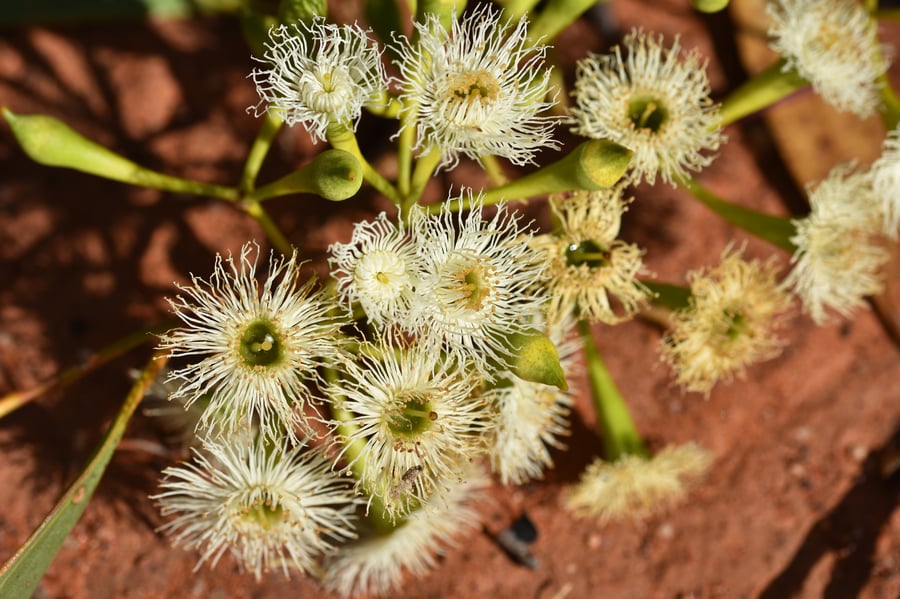
Yapunyah is a winter honey from the inland rivers, but its real crop comes only after those rivers flood.
The tree, Eucalyptus ochrophloia, is a small box eucalypt of the inland river country of south-west Queensland and the far north-west corner of New South Wales – the Bulloo, Paroo, Ward, and Warrego, the channel-country rivers that run only after rain. It is drought-hardy and unremarkable in a dry year. What makes it a honey tree is its timing: it flowers in winter, when almost nothing else in that country is in flower, so a hive working a yapunyah stand has the field largely to itself. The nectar is enough, in a winter bloom, to draw honeyeaters and insects to the canopy.
But the crop that beekeepers move hundreds of kilometres for comes after the rivers fill. The big yapunyah flows follow flooding in the channel country – water that may have fallen in central Queensland weeks earlier and travelled down the floodplains to recharge the ground these trees stand in. In long dry runs the trees survive and yield little; after a flood, they can flower heavily. A jar of yapunyah is therefore keyed to a rainfall cycle no beekeeper schedules, and good years and lean years on the shelf track the wet years and dry years on the Paroo.
The honey itself is light for an inland eucalypt – pale to light amber, mild, with a warm caramel note and a slight tannin finish. It crystallises readily, the more so in cool weather, to a fine creamy grain. And it carries a small forensic signature: among Australian eucalypt honeys, yapunyah is one of the few that lacks the flavonoid myricetin, a difference clear enough to help tell its floral origin apart in the laboratory.
Characteristics
Yapunyah is pale to light amber, noticeably lighter than the red gum and stringybark honeys of the same broad inland country. The aroma is gentle and warm; the flavour follows it – mild and well-balanced, with a soft caramel character, a touch of fruit, and a light tannin finish that keeps the sweetness from turning cloying. It is less assertive than ironbark and more characterful than yellow box, which is part of why it is valued as an everyday honey rather than a strong specialty one. Its defining physical behaviour is its crystallisation: it sets readily, the more quickly in cool weather, to a fine, smooth, creamy grain, and is often used as a base for creamed honey. The set changes the texture, not the flavour.
Click to Display — The Details: botanical origin, sensory profile, pairings, health and what gives it its character
Botanical Name: Yapunyah (Eucalyptus ochrophloia)
Botanical Family: Myrtaceae
Bee Species:
Apis mellifera, the introduced European honey bee, which carries all commercial yapunyah production. Hives are trucked into the inland river stands to work the winter flow.
Color:
pale to light amber
Flavor Profile:
mild and warm – soft caramel, a touch of fruit, light tannin finish
Tasting Notes:
Yapunyah is a mild honey that rewards attention rather than demanding it. The caramel note is soft and warm rather than rich or burnt, carried on a clean sweetness with a light tannin finish that keeps it from cloying. Producers and the wider record converge on the same small cluster of descriptors – warm caramel, slightly fruity, smooth – which is itself telling for a single-source honey from a remote run. Sold young it pours as a light liquid; left on the shelf it sets to a fine creamy grain, and the caramel reads a little rounder through the set texture than in the liquid.
Aroma:
gentle, warm, lightly caramel
Defining Compounds:
Yapunyah carries a measurable floral signature. In a study of the flavonoid profiles of Australian eucalypt honeys, yapunyah was one of a small group – alongside narrow-leaved ironbark and black box – in which the flavonoid myricetin was not detected, where related honeys such as bloodwood carry it as a main compound. In its place, yapunyah’s profile rests on tricetin, quercetin, and luteolin. The point is not a health claim but an identity one: because floral type leaves a fingerprint in a honey’s flavonoids, the absence of myricetin is one of the markers that can be used to tell yapunyah’s botanical origin apart from other eucalypt honeys in the laboratory. Yapunyah is recognised in the research literature as a source of antioxidant phenolic compounds, though it is not sold on the graded antibacterial scales used for jarrah or the Leptospermum honeys.
Forage Origin:
Yapunyah honey comes from the nectar of Eucalyptus ochrophloia, a box eucalypt in the family Myrtaceae. In the botanical classification of the eucalypts it sits in section Adnataria – the boxes – and pairs with its nearest relative, the more northern E. thozetiana, in the small series Coalitae; the two are set apart from the other boxes by their obscure leaf venation and the fused bud caps that drop at flowering. It is a modest tree, usually around 15 metres, occasionally to 20, with a stocking of rough dark bark on the lower trunk giving way abruptly to smooth pale bark above – grey, coppery, pink, yellow, or brown. That pale upper bark is what the species name records: ochrophloia, from the Greek for “pale yellow bark.”
The tree is confined to the inland channel country, scattered along the Bulloo, Paroo, Ward, and Warrego river systems of south-west Queensland and far north-west New South Wales, often in the company of gidgee and on the floodplains that the rivers recharge. Its distribution is the honey’s distribution: this is not a tree of the coast or the ranges but of the dry inland rivers, and the honey belongs to that country.
A buyer should know the names overlap. Yapunyah is also written napunyah, and the same tree is called yellow jacket and, regionally, black butt – the latter a confusing borrowing, since “blackbutt” usually names quite different eucalypts; here it refers to the dark lower bark. Only honey from Eucalyptus ochrophloia is true yapunyah. Other inland eucalypts sold as “yellow jacket” produce different honeys, and the label alone, without the botanical name, does not settle the source.
Pairings:
Yapunyah’s mild, warm character makes it a versatile table and breakfast honey rather than a strong finishing one. It suits tea, drizzling over yoghurt, and everyday baking, and the slight tannin finish gives it enough backbone to stand up to heavier breakfast foods such as porridge and dense bread. Once it has set to its creamy grain it spreads well on warm toast.
Origin Story
The species was first formally described in 1878 by the Victorian government botanist Ferdinand von Mueller, in his Fragmenta Phytographiae Australiae; the specimen that anchors the name is recorded from the Paroo River. Von Mueller gave it a Greek scientific name for its pale bark, but the name the honey trade settled on came from the country itself.
“Yapunyah” is an Aboriginal word. It is a borrowing from the Kunja (Gunya) language of south-west Queensland, from yapany, the Kunja name for the tree; the Oxford English Dictionary and other sources trace the English word to that origin. As pastoralists and apiarists moved into the inland in the nineteenth and twentieth centuries, they took up the local name for a tree they valued for durable timber – fence posts and heavy construction – and, later, for its winter honey, and it passed into Australian English as yapunyah. The honey is sold today under the word the Kunja used for the tree.
The country the tree defines carries that history. The Paroo and Warrego are the rivers of the Kunja, Budjiti, Mardigan, and Baakandji peoples, among others; the Paroo is the last free-flowing river in the northern Murray-Darling Basin, and in a land where permanent water is rare its waterholes have long been vital refuges. The tree’s name travels with the country: a permanent waterhole in the Cooper Creek catchment to the north-west, in the Lake Eyre Basin, is itself called Yapunyah – a documented Aboriginal refuge, though well outside the rivers where the honey is made.
Harvest & Forage
Yapunyah’s flowering and its cropping are two different things. The tree flowers in winter – flowering has been recorded across the months from May to November – which is its first advantage to a beekeeper: in that season little else in the inland country is in flower, so a yapunyah stand offers a relatively clean single-source flow without the overlap that dilutes other monofloral crops. The second factor is water. The heavy nectar flows follow flooding in the channel country; the rivers run only after rain, and a good yapunyah season tends to follow a wet one, sometimes with a lag as floodwater travels down the floodplains from headwaters far to the north. The rainfall that drives this is irregular and tied to the longer Pacific climate cycles that govern inland Australian flooding, so yapunyah is among the most weather-event-driven of Australia’s named honeys: opportunistic, and concentrated in the years after the country has flooded.
This shapes how the honey is produced. It is a crop of migratory commercial apiaries working the inland rivers across both sides of the Queensland – New South Wales border, moving hives in when a stand comes into a good winter flow after rain, rather than a fixed annual harvest. The crop is event-driven enough that an entire season’s flow can build and then dissipate as the country dries, with hives moved off to other flora when it does. Yields are correspondingly variable from year to year.
Beekeeping Context
Yapunyah is a honey of the outback apiary. It reaches buyers chiefly direct from the beekeeper rather than through bulk packing, which suits a crop that is irregular, regional, and sold on its single-source character. St George Honey, working hives along the Paroo River in south-west Queensland, is among the producers selling it as a named single-varietal – raw, unheated, and described in the same terms the wider record converges on: light in colour, smooth, with a warm caramel and slightly fruity flavour, from a single origin and a single flowering. It is the kind of honey that rewards knowing where it came from and in which year.
Source Regions
- Eucalyptus ochrophloia – Australia – Queensland (Channel Country; Warrego, Paroo, and Bulloo river systems): primary production region. Hives are worked on the inland rivers, with producers such as St George Honey on the Paroo.
- Eucalyptus ochrophloia – Australia – New South Wales (far north-west; North Far Western Plains, Paroo north of White Cliffs): secondary production region, the southern reaches of the same channel-country river systems. The same honey from one continuous distribution, not a distinct regional type; yapunyah is reported among the inland flows worked by New South Wales beekeepers.